





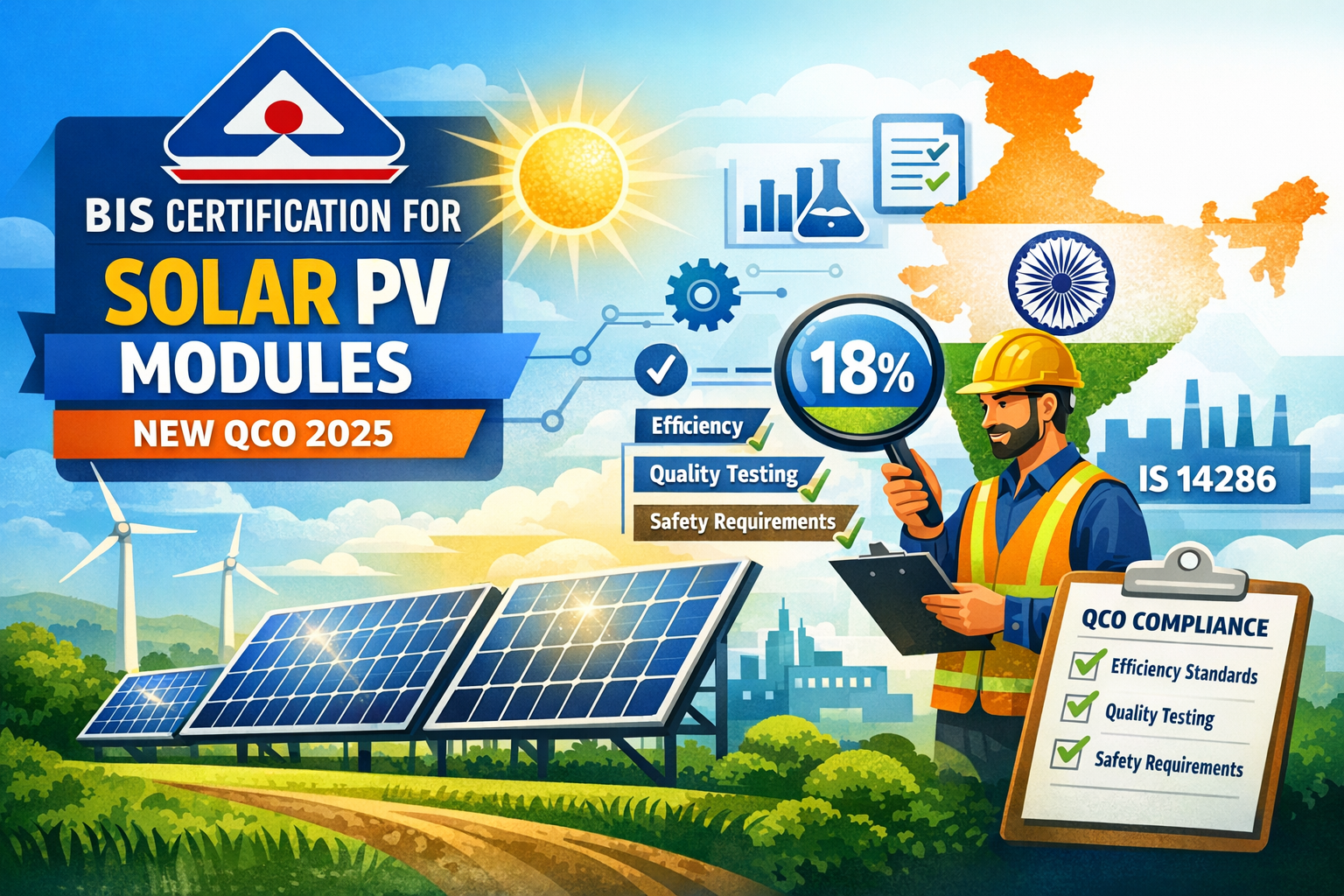
The Government of India has introduced new regulatory guidelines for Solar Photovoltaic (PV) Modules through the Solar Systems, Devices and Components Goods Order, 2025. This order has been issued by the Ministry of New and Renewable Energy (MNRE) and implemented through the Bureau of Indian Standards (BIS). The revised Quality Control Order (QCO) replaces the earlier 2017 order and introduces updated standards, testing procedures, and efficiency requirements for manufacturers and importers of solar PV modules in India.
The purpose of this regulation is to improve product quality, safety, and efficiency in solar power equipment used in India. With the rapid growth of renewable energy, the government wants to ensure that solar PV modules used in installations meet internationally recognized quality benchmarks.
Overview of the New QCO for Solar PV Modules
The Solar Systems, Devices and Components Goods Order, 2025 requires that all specified solar products must comply with the latest Indian Standards and must carry the BIS Standard Mark. The regulation applies to several components used in solar energy systems, including:
Crystalline Silicon Terrestrial Photovoltaic (PV) Modules
Thin-Film Terrestrial Photovoltaic (PV) Modules
Solar storage batteries
Power inverters used in photovoltaic power systems
Utility-interconnected photovoltaic inverters
These products must comply with relevant BIS standards before they can be manufactured, imported, or sold in India. Products intended solely for export are exempt from these requirements.
Updated BIS Standards for Solar PV Modules
Under the revised QCO, the BIS has introduced updated testing and certification standards for solar modules. The major standards applicable to PV modules include:
IS 14286 (Part 1): 2023 / IEC 61215-1:2021 – Design qualification and type approval requirements for PV modules.
IS/IEC 61730-1:2016 – Safety qualification requirements for construction of photovoltaic modules.
IS/IEC 61730-2:2016 – Safety testing requirements for photovoltaic modules.
These updated standards replace older standards such as IS 14286:2010 and IS 16077:2013, which were previously used for certification. The revised standards align Indian testing requirements with the latest international IEC standards.
Minimum Efficiency Requirement for Solar Modules
One of the most significant changes in the new QCO is the introduction of minimum efficiency criteria for solar PV modules.
The efficiency requirement under Standard Test Conditions (STC) is:
18% efficiency for Mono Crystalline Silicon PV Modules
18% efficiency for Thin-Film PV Modules
17% efficiency for Poly Crystalline Silicon PV Modules
The efficiency is calculated based on the ratio between the maximum PV output and the module surface area using the formula:
Efficiency = (Pmax / (1000 × Area)) × 100
Where Pmax represents the maximum power output in watts and Area represents the surface area of the module in square meters.
This requirement ensures that only high-performance modules are approved for use in solar projects across India.
Compliance Guidelines for Existing License Holders
Manufacturers who already hold BIS licenses for solar PV modules must upgrade their certification according to the new standards within the timeline specified in the QCO.
Key requirements include:
Existing models must undergo testing according to IS 14286 (Part 1): 2023 and related standards.
Manufacturers must submit updated test reports from recognized third-party laboratories.
Applications for standard revisions must be submitted through the BIS online portal.
Non-compliant models will be removed from the license scope after the deadline.
If manufacturers fail to comply with the revised standards within the given timeline, their BIS license may expire or be cancelled.
Guidelines for New Applicants
Companies applying for a new BIS license for solar PV modules must directly comply with the new standards. The application must include test reports confirming compliance with:
IS 14286 (Part 1) series
IS/IEC 61730-1:2016
IS/IEC 61730-2:2016
Applications based on the old standards were permitted only until 27 July 2025. After this date, all new applications must strictly follow the revised QCO requirements.
Changes in Testing and Product Qualification
The revised standards also introduce several improvements in testing procedures, including:
New module quality tests (MQTs)
Updated sampling procedures
Improved marking and documentation requirements
New mechanical load and bending tests
Tests for potential-induced degradation (PID)
Updated insulation and hotspot endurance tests
These improvements ensure better reliability, durability, and safety of solar PV modules used in power generation systems.
Conclusion
The Solar Systems, Devices and Components Goods Order, 2025 represents a significant step toward improving the quality and performance of solar equipment in India. By introducing updated BIS standards, stricter testing procedures, and minimum efficiency requirements, the government aims to promote reliable solar infrastructure across the country.
Manufacturers, importers, and suppliers must carefully review these guidelines and ensure compliance with the revised QCO to continue operating in the Indian market. Early implementation of these requirements will help companies avoid regulatory issues while contributing to India’s rapidly expanding renewable energy sector.