








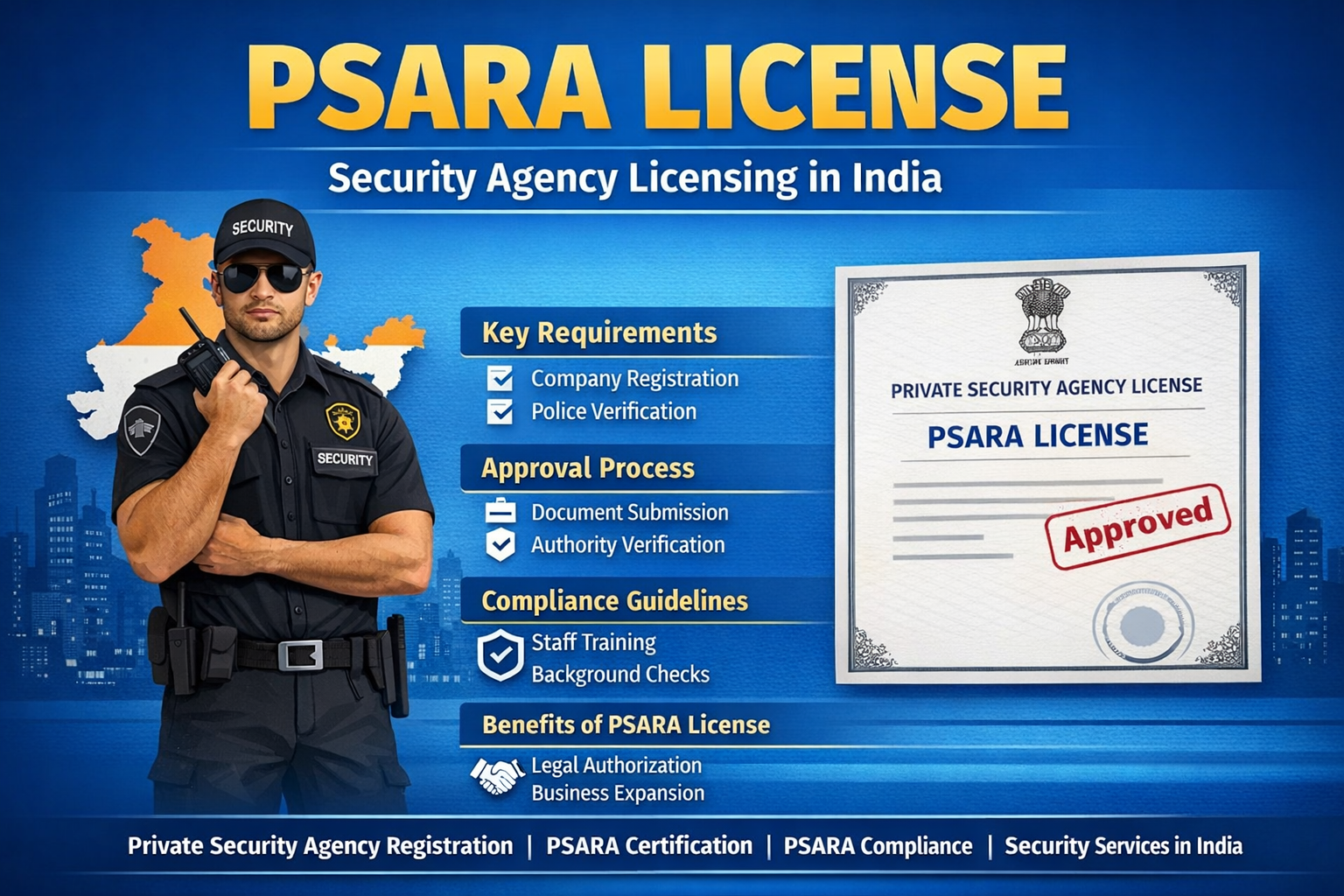
The private security industry in India has grown rapidly due to increasing demand for professional security services in residential complexes, corporate offices, malls, hospitals, and industrial areas. However, operating a private security agency without proper authorization is illegal. Businesses must obtain a PSARA License to legally provide security services.
The Private Security Agencies Regulation Act (PSARA) was introduced by the Government of India to regulate private security agencies and ensure quality, accountability, and professional standards. Obtaining a PSARA License ensures that the security agency follows government regulations and maintains proper compliance standards.
If you plan to start a private security company, understanding the PSARA approval process, documentation requirements, and compliance guidelines is essential. Many businesses seek assistance from professional consultants such as Indiannexus to ensure smooth and fast approval.
This blog explains the PSARA License, its benefits, the application process, the documents required, and the compliance requirements in India.
What is the PSARA License?
A PSARA License is a mandatory legal authorization required to start and operate a private security agency in India. The license is issued under the Private Security Agencies Regulation Act, 2005 (PSARA).
The objective of PSARA is to regulate security service providers and maintain professionalism in the private security sector. It ensures that security agencies employ trained personnel and follow proper operational guidelines.
The PSARA License is issued by the respective state government authorities. Without this license, any company providing security services can face legal penalties.
The license also ensures proper PSARA compliance, including employee background verification, training standards, and operational transparency.
Importance of PSARA License for Security Agencies
Obtaining a PSARA License offers several advantages for security agencies and clients.
1. Legal Authorization
The PSARA License allows businesses to legally operate as security service providers in India.
2. Builds Client Trust
Clients prefer hiring licensed agencies because they follow proper PSARA certification standards.
3. Regulatory Compliance
The license ensures compliance with the PSARA approval process and regulatory norms.
4. Professional Credibility
Licensed agencies gain credibility and recognition in the market.
5. Business Expansion
A valid PSARA License allows companies to expand their services across multiple states.
PSARA Approval Process in India
The PSARA approval process involves multiple steps and verification procedures.
Step 1: Company Registration
The business must first register as a legal entity, such as:
Private Limited Company
LLP
Partnership Firm
Sole Proprietorship
Step 2: MOU with Training Institute
Security agencies must sign an agreement with a government-approved training institute to provide training to guards.
Step 3: Police Verification
Police verification is conducted for all directors, promoters, and key management personnel.
Step 4: Application Submission
The application for PSARA License is submitted to the state controlling authority with required documents.
Step 5: Department Verification
Authorities verify all documents and ensure the agency meets PSARA compliance standards.
Step 6: License Issuance
After successful verification, the government issues the PSARA License.
Professional consultants like Indiannexus assist businesses throughout the Security Agency Licensing India process to avoid delays and errors.
Documents Required for PSARA License
To obtain a PSARA License, businesses must submit several documents, including:
Company registration certificate
PAN card of the company
Address proof of office
Identity proof of directors
Employee training agreement
Affidavit as per PSARA rules
Police verification certificates
GST registration (if applicable)
Details of security guards and supervisors
Proper documentation is essential to complete the Private Security Agency Registration process successfully.
PSARA Compliance Requirements
After obtaining the PSARA License, agencies must follow strict compliance guidelines.
Key PSARA compliance requirements include:
Hiring trained security personnel
Conducting employee background checks
Maintaining training records
Issuing uniforms and ID cards
Keeping service records
Following state-specific regulations
Failure to maintain compliance can lead to suspension or cancellation of the PSARA License.
Role of PSARA Consultants
Applying for a PSARA License can be complicated due to legal procedures and documentation requirements. Professional consultants help simplify the process.
Consulting firms like Indiannexus assist with:
Document preparation
Application filing
Police verification coordination
Training institute arrangements
Regulatory compliance support
Their expertise ensures faster approval and smoother Security Agency Licensing India procedures.
Conclusion
The private security industry plays a critical role in maintaining safety across commercial and residential sectors. However, operating legally requires obtaining a PSARA License under government regulations.
The PSARA License ensures that security agencies follow proper training standards, background verification procedures, and operational guidelines. Completing the PSARA approval process and maintaining PSARA compliance is essential for long-term success in the security services industry.
With expert guidance from professional consultants like Indiannexus, businesses can complete their Private Security Agency Registration efficiently and operate legally in India.
FAQs on PSARA License
1. What is the PSARA License?
A PSARA License is a legal authorization required to operate a private security agency in India under the Private Security Agencies Regulation Act.
2. Who needs a PSARA License?
Any company or individual providing security guard services must obtain a PSARA License.
3. How long does it take to get a PSARA License?
The PSARA approval process usually takes 60–90 days, depending on the state authority.
4. Is the PSARA License mandatory?
Yes, operating a security agency without a PSARA License is illegal in India.
5. What is the validity of the PSARA License?
The validity of a PSARA License varies by state but generally ranges from 1 to 5 years.
6. Can the PSARA License be transferred to another state?
No, a PSARA License is issued state-wise. Separate licenses are required for different states.
7. What happens if a security agency operates without a PSARA License?
The agency may face legal penalties, fines, and business closure.