








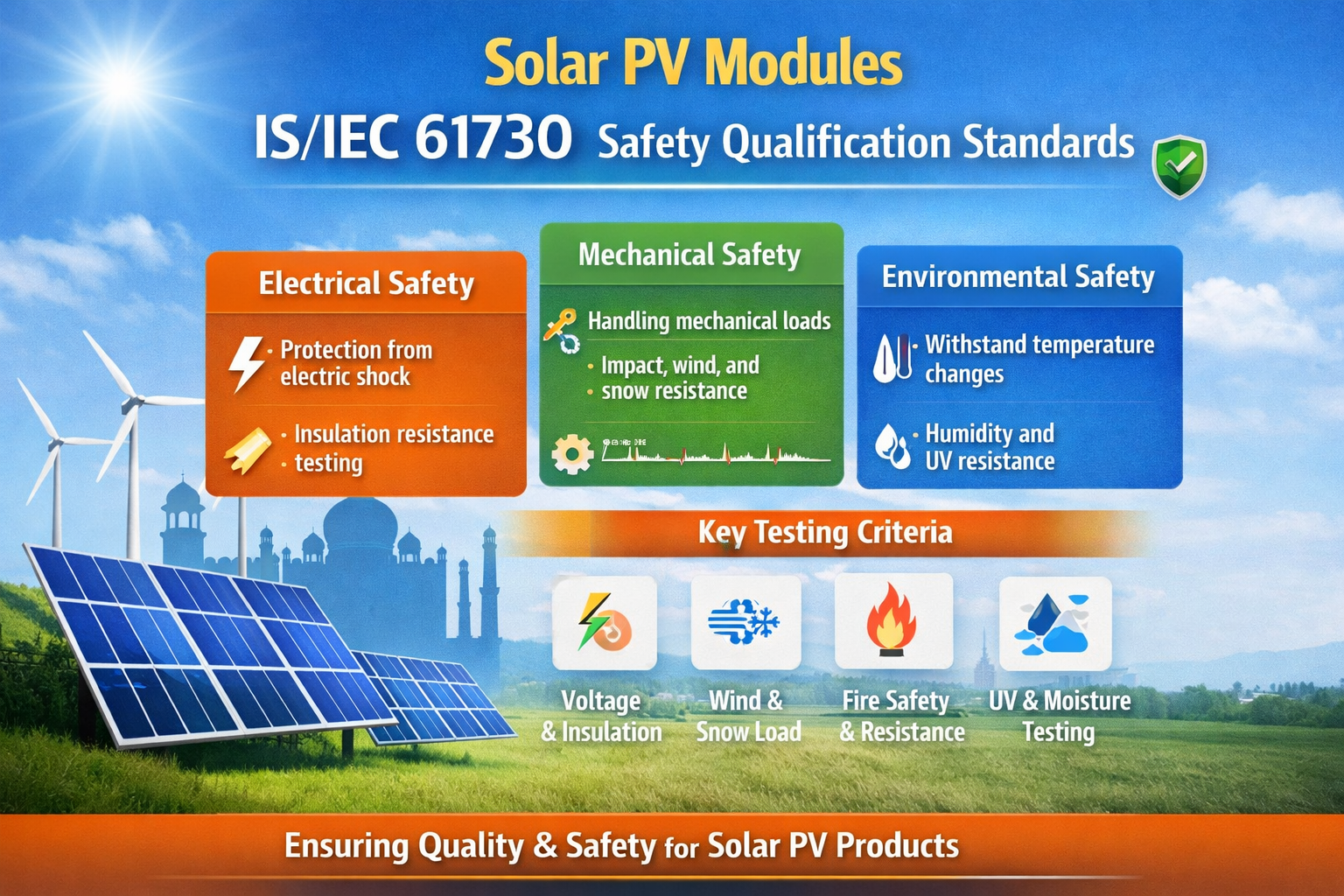
The solar energy sector in India is rapidly expanding as the country moves toward clean and renewable energy sources. To ensure safety, reliability, and quality in solar photovoltaic (PV) products, the Bureau of Indian Standards (BIS) regularly updates its standards and compliance requirements. Recently, BIS issued updated guidelines regarding the transition of Solar PV Modules from IS/IEC 61730:2016 to the revised IS/IEC 61730:2023 standards.
These updated guidelines are crucial for manufacturers, importers, and businesses involved in solar module production or distribution in India. Understanding the transition process, timelines, and testing requirements will help companies maintain compliance and continue operating smoothly in the solar market.
Introduction to the Revised BIS Standards
The Ministry of New and Renewable Energy (MNRE) introduced the Solar Systems, Devices and Components Goods Order, 2025, which came into effect on 27 July 2025. This order replaced the earlier Solar Photovoltaics Goods Order of 2017 and reinforced the requirement for BIS registration for solar PV modules.
Under this order, solar modules must comply with safety standards that evaluate construction and testing requirements for PV module safety qualification. Previously, the applicable standards were:
IS/IEC 61730-1:2016 – Construction requirements for PV modules
IS/IEC 61730-2:2016 – Testing requirements for PV modules
However, these standards have now been revised to:
IS/IEC 61730-1:2023
IS/IEC 61730-2:2023
The two versions will run concurrently until 15 February 2027, allowing manufacturers enough time to transition to the new requirements.
Transition Requirements for Existing Solar PV Modules
Manufacturers whose products are already tested according to the 2016 standards must upgrade their compliance to the 2023 standards through partial testing and verification.
For this transition, BIS requires certain additional tests depending on the type of solar module:
1. Bifacial Solar Modules
For bifacial modules, most test sequences specified in the 2023 standards must be performed again. However, some tests such as:
Sequence A
Fire Test (MST 23)
Peel Test (MST 35)
Screw Connection Test (MST 33)
may be omitted during the transition testing process.
2. Monofacial Modules
For monofacial modules and bifacial modules with declared aBSI equal to 300 W/m², the testing requirements are slightly relaxed. Some test sequences like B, B1, C, and E may be skipped while performing the compliance evaluation.
These selective testing requirements are designed to simplify the transition process without compromising product safety or performance.
Implementation Procedure for Manufacturers
To implement the revised standards, manufacturers holding BIS licenses for solar PV modules must follow a defined process.
First, the manufacturer must test the representative model of the product family according to the updated requirements. This model acts as the primary reference for verifying compliance with the new standards.
If a product family contains multiple Bills of Materials (BOMs), additional retesting may be required to ensure that all variations meet the revised standard requirements.
After completing the testing, manufacturers must submit their applications through the BIS online portal using the Standard Revision or Amendment module. The application must include updated test reports issued by an authorized third-party testing laboratory.
Once BIS verifies the submitted documents and reports, the authority issues an official confirmation letter indicating that the product models comply with the revised standards.
Key Technical Changes in the 2023 Standards
The updated IS/IEC 61730:2023 standards include several technical improvements and clarifications to enhance solar module safety.
Some of the major changes include:
1. New Requirements for Junction Boxes and Connectors
The revised standards introduce additional qualification requirements for components such as junction boxes, connectors, and polymeric backsheets. These materials must comply with specific international standards and must be verified through certified testing.
2. Updated Insulation Coordination Requirements
The standards introduce improved insulation coordination guidelines. These include updated definitions, measurements, and testing procedures related to insulation materials and electrical spacing inside the module.
3. Special Provisions for Bifacial Modules
Since bifacial modules generate electricity from both sides, the revised standards introduce new parameters such as aBSI and additional testing conditions to ensure safety under higher current conditions.
4. Improved Marking and Documentation Requirements
Manufacturers must now provide additional details on module labels, including:
Design load rating
Module operating temperature
Connector specifications
Identification of front or rear surfaces for bifacial modules
These updates improve product traceability and installation safety.
Guidelines for New Solar PV Models
Manufacturers introducing new solar PV modules are encouraged to directly comply with the latest standards:
IS 14286 (Part 1/Sec X): 2023
IS/IEC 61730-1: 2023
IS/IEC 61730-2: 2023
However, BIS allows manufacturers to initially apply using the 2016 standards if required, provided that they complete the transition to the 2023 standards before the 15 February 2027 deadline.
Deadline and Compliance Consequences
The transition period ends on 15 February 2027. After this date:
BIS will not grant new licenses for solar PV modules based on the 2016 standards.
Non-compliant models will be removed from the license scope.
Manufacturers failing to update their certifications may face regulatory action.
Therefore, companies must plan their testing, documentation, and application process well in advance to avoid disruptions in their business operations.
Conclusion
The revised IS/IEC 61730:2023 standards represent an important step toward improving the safety and reliability of solar PV modules in India. These updates align Indian regulations with global best practices while addressing the evolving design of modern solar modules such as bifacial technology.
For manufacturers and importers, timely compliance with these updated BIS guidelines is essential. By conducting the required tests, updating product documentation, and submitting the necessary applications before the transition deadline, companies can ensure uninterrupted market access and maintain regulatory compliance in India’s growing solar energy sector.