








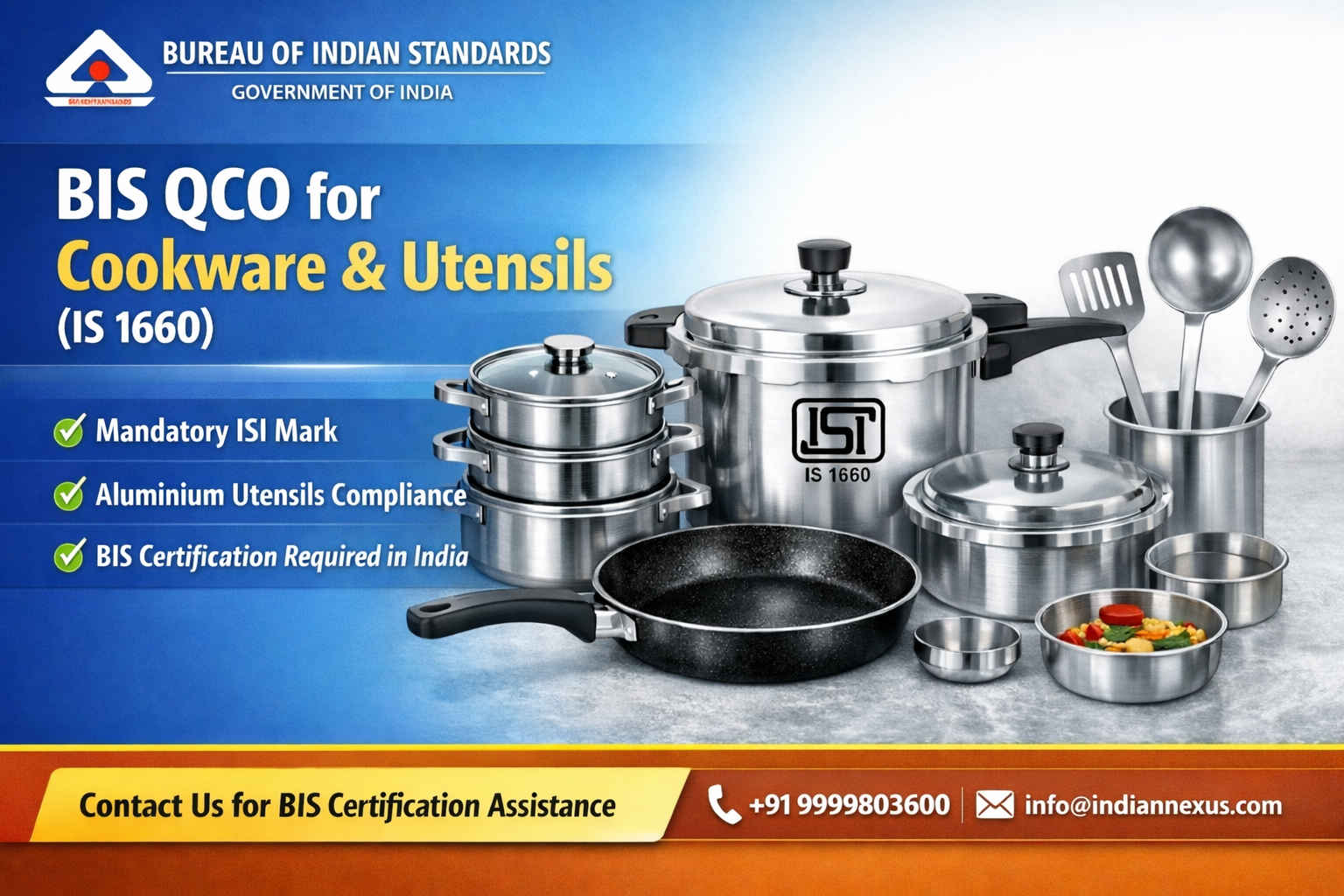
The Government of India has been strengthening product quality and safety standards through various regulations issued under the Quality Control Orders (QCOs) framework. One such important regulation applies to cookware and utensils used in households and commercial kitchens. The BIS QCO for Cookware and Utensils IS 1660 aims to ensure that products used for cooking and food preparation meet strict safety and quality standards before being sold in the Indian market.
This regulation mandates that certain cookware and utensils must comply with the Indian Standard IS 1660 and obtain certification from the Bureau of Indian Standards (BIS). The certification allows manufacturers to use the ISI mark, which confirms that the product meets the required safety, durability, and quality benchmarks.
What is BIS QCO for Cookware and Utensils IS 1660?
The BIS QCO for Cookware and Utensils IS 1660 is a government regulation that makes BIS certification mandatory for specific cookware and utensil products. These products must comply with the technical requirements specified under IS 1660, which mainly covers aluminium alloy utensils used for cooking and serving food.
The objective of this order is to protect consumers from substandard or unsafe cookware products that may pose health risks. Cookware that does not meet the required composition, durability, and safety standards may contaminate food or deteriorate quickly during use. Under this regulation, manufacturers cannot manufacture, store, sell, distribute, or import such products in India without obtaining a valid BIS ISI license.
Importance of IS 1660 Standard
The IS 1660 standard focuses on the quality and safety of aluminium cookware and utensils. It specifies requirements related to:
Raw material quality
Alloy composition
Thickness and strength
Surface finish
Manufacturing processes
Safety and hygiene requirements
These guidelines ensure that cookware products remain safe for cooking, do not react negatively with food, and maintain durability over long-term usage.
By enforcing the BIS QCO for Cookware and Utensils IS 1660, the government ensures that only certified and tested products reach consumers.
Products Covered Under BIS QCO for Cookware and Utensils
The Quality Control Order applies to various aluminium utensils commonly used in Indian kitchens. Some examples include:
Aluminium cooking pots
Aluminium pans
Aluminium cooking vessels
Aluminium utensils used for serving food
Household aluminium cookware items
All such products must comply with IS 1660 standards and carry the ISI mark issued by the Bureau of Indian Standards.
BIS Certification Process for Cookware and Utensils
Manufacturers must follow a specific process to obtain BIS certification under the BIS QCO for Cookware and Utensils IS 1660. The key steps include:
1. Application Submission
Manufacturers must submit an application for BIS certification along with company details, manufacturing information, and product specifications.
2. Product Testing
Samples of cookware or utensils are tested in BIS-recognized laboratories to verify compliance with IS 1660 standards.
3. Factory Inspection
BIS officials conduct a factory inspection to evaluate the manufacturing process, quality control systems, and testing facilities.
4. Grant of BIS License
If the product and manufacturing facility meet all the required standards, BIS grants an ISI license, allowing the manufacturer to mark products with the ISI logo.
Documents Required for BIS Certification
To apply for certification under BIS QCO for Cookware and Utensils IS 1660, manufacturers must submit several documents, including:
Business registration documents
Manufacturing unit details
Product specifications
Raw material information
Test reports from BIS-approved laboratories
Quality control documentation
Accurate documentation helps streamline the approval process and ensures faster certification.
Benefits of BIS Certification for Cookware and Utensils
Obtaining BIS certification under the BIS QCO for Cookware and Utensils IS 1660 offers several advantages for manufacturers and consumers.
Consumer Safety
The certification ensures cookware is safe for cooking and does not pose health risks.
Improved Product Quality
Strict quality testing ensures durability, strength, and safe food contact materials.
Legal Compliance
Manufacturers must comply with the Quality Control Order to legally sell products in India.
Market Trust
The ISI mark builds consumer confidence and enhances brand reputation in the market.
Protection from Substandard Products
Mandatory certification prevents low-quality or counterfeit cookware from entering the market.
Consequences of Non-Compliance
Manufacturers or importers who fail to comply with the BIS QCO for Cookware and Utensils IS 1660 may face legal consequences. These may include:
Product recalls
Monetary penalties
Prohibition on sale or distribution
Legal action under BIS regulations
Therefore, businesses need to obtain proper certification before launching cookware products in the Indian market.
Conclusion
The BIS QCO for Cookware and Utensils IS 1660 plays a crucial role in maintaining quality and safety standards for cookware used by millions of households across India. By mandating compliance with IS 1660, the government ensures that aluminium utensils meet strict manufacturing and safety guidelines.
Manufacturers and importers must obtain certification from the Bureau of Indian Standards before selling such products. This not only ensures regulatory compliance but also helps build consumer trust through the widely recognized ISI mark.