







Drone usage in India has grown rapidly across industries such as agriculture, surveillance, filmmaking, logistics, and infrastructure. To regulate this expanding sector and ensure safety, the Government of India has established clear rules for drone registration under the Directorate General of Civil Aviation (DGCA). If you plan to operate a drone commercially or even for certain personal uses, understanding the registration process is essential.
What is Drone Registration in India?
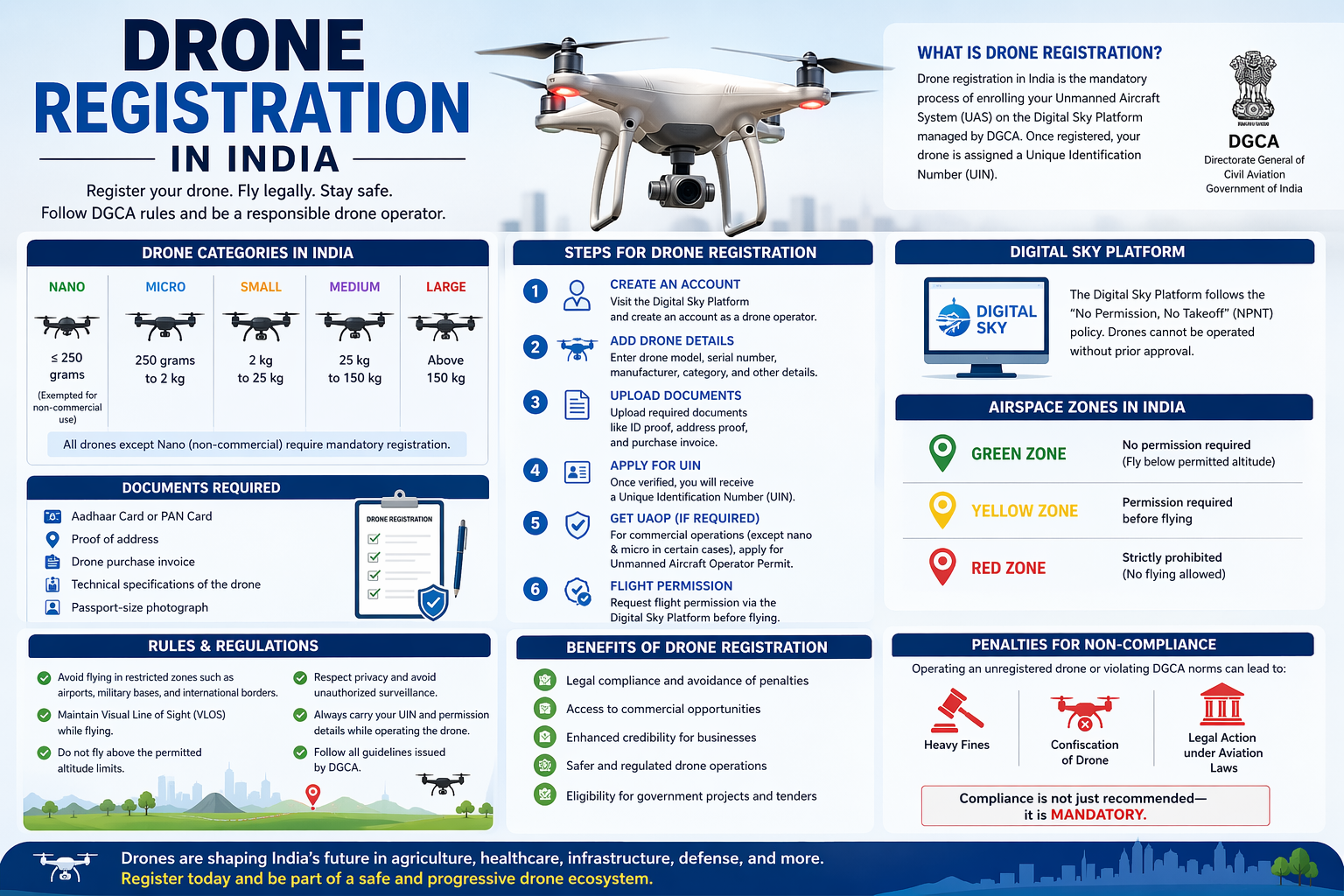
Drone registration in India refers to the mandatory process of enrolling your unmanned aircraft system (UAS) on the Digital Sky Platform. This platform is an online system developed by the DGCA to manage drone operations across the country. Every drone, except those in the nano category used for non-commercial purposes, must be registered and assigned a Unique Identification Number (UIN).
Categories of Drones in India
Before registration, it is important to understand drone classifications:
Nano Drone: Less than or equal to 250 grams
Micro Drone: 250 grams to 2 kg
Small Drone: 2 kg to 25 kg
Medium Drone: 25 kg to 150 kg
Large Drone: Above 150 kg
Only nano drones used for recreational purposes are exempt from registration. All other categories require mandatory registration.
Digital Sky Platform
The Digital Sky Platform acts as the backbone of drone regulation in India. It follows a “No Permission, No Takeoff” (NPNT) policy, meaning drones cannot operate without prior approval through the platform. Operators must register themselves, their drones, and apply for flight permissions.
Steps for Drone Registration
The drone registration process is straightforward if you follow these steps:
Create an Account
Visit the Digital Sky website and create an account as a drone operator.Add Drone Details
Enter details such as drone model, serial number, manufacturer, and category.Upload Required Documents
Documents typically include:ID proof of the owner
Address proof
Invoice or ownership proof of the drone
Apply for UIN
Once details are verified, you will receive a Unique Identification Number (UIN) for your drone.Get UAOP (if required)
For commercial operations (except nano and micro drones in certain cases), you may need an Unmanned Aircraft Operator Permit (UAOP).Flight Permission
Before flying, request permission via the Digital Sky Platform.
Documents Required
To ensure a smooth registration process, keep the following documents ready:
Aadhaar Card or PAN Card
Proof of address
Drone purchase invoice
Technical specifications of the drone
Passport-size photograph
Cost of Drone Registration
The government has kept registration fees minimal to promote ease of doing business. Fees may vary depending on drone category and type of operation, but they are generally affordable for individuals and businesses alike.
Rules and Regulations
Drone operators in India must follow strict guidelines:
Avoid flying in restricted zones such as airports, military bases, and international borders.
Maintain visual line of sight (VLOS) while flying.
Do not fly above the permitted altitude limits.
Respect privacy and avoid unauthorized surveillance.
Always carry your UIN and permission details while operating the drone.
India has divided airspace into three zones:
Green Zone: No permission required (below a certain altitude)
Yellow Zone: Requires permission
Red Zone: Strictly prohibited
Benefits of Drone Registration
Registering your drone offers several advantages:
Legal compliance and avoidance of penalties
Access to commercial opportunities
Enhanced credibility for businesses
Safer and regulated drone operations
Eligibility for government projects and tenders
Penalties for Non-Compliance
Operating an unregistered drone or violating DGCA norms can lead to serious consequences, including:
Heavy fines
Confiscation of the drone
Legal action under aviation laws
Therefore, compliance is not just recommended—it is mandatory.
Future of Drones in India
The Indian government is actively promoting drone technology through initiatives like Drone Shakti and Production Linked Incentive (PLI) schemes. With increasing adoption in sectors like agriculture (crop spraying), healthcare (medicine delivery), and infrastructure (surveying), drones are set to become a key part of India’s technological ecosystem.
Conclusion
Drone registration in India is a crucial step for anyone looking to operate drones legally and safely. With the Digital Sky Platform simplifying the process, getting your drone registered has become quick and efficient. Whether you are a hobbyist or a business owner, compliance with DGCA regulations ensures smooth operations and opens up new opportunities in this fast-growing industry.
If you plan to use drones professionally, consulting with experts or agencies can further streamline the process and help you stay updated with evolving regulations.