





Shall we start with our introductions. You're an importer, manufacturer or a brand owner, seeking to venture out into India. You must be wondering what the difference between BIS Registration vs ISI Certification in India is. Both certifications fall under the purview of the Bureau of Indian Standards (BIS), but they're different. Let's find out how…
To safeguard consumers' health and uphold product quality standards, India has set strict standards and quality control guidelines. Businesses in the manufacturing sector must register their product, either with the BIS CRS Registration or the ISI Mark Certification. If manufacturers fail to register their products properly, their goods will face penalties, boycotts, and recalls.
At Indiannexus, we assist your business to get the right certification for your product type with a smooth approval process.
What is BIS Registration?
BIS Registration India generally refers to product registration under the BIS CRS Scheme (Compulsory Registration Scheme). This scheme is primarily applicable to electronic and IT products notified by the Government of India.
Under the CRS framework, manufacturers must:
Test products in BIS-recognized laboratories
Submit test reports and technical documents
Apply for registration through BIS
Obtain authorization before selling products in India
The BIS Approval Process ensures that products comply with applicable Indian safety standards.
What is ISI Certification?
ISI Certification India is a product certification scheme that allows manufacturers to use the ISI mark on products that meet specific Indian Standards.
An ISI Mark License is generally mandatory for products such as:
Cement
Steel products
Household goods
ISI mark indicates the product has met quality and safety standards and ensures consumer's confidence
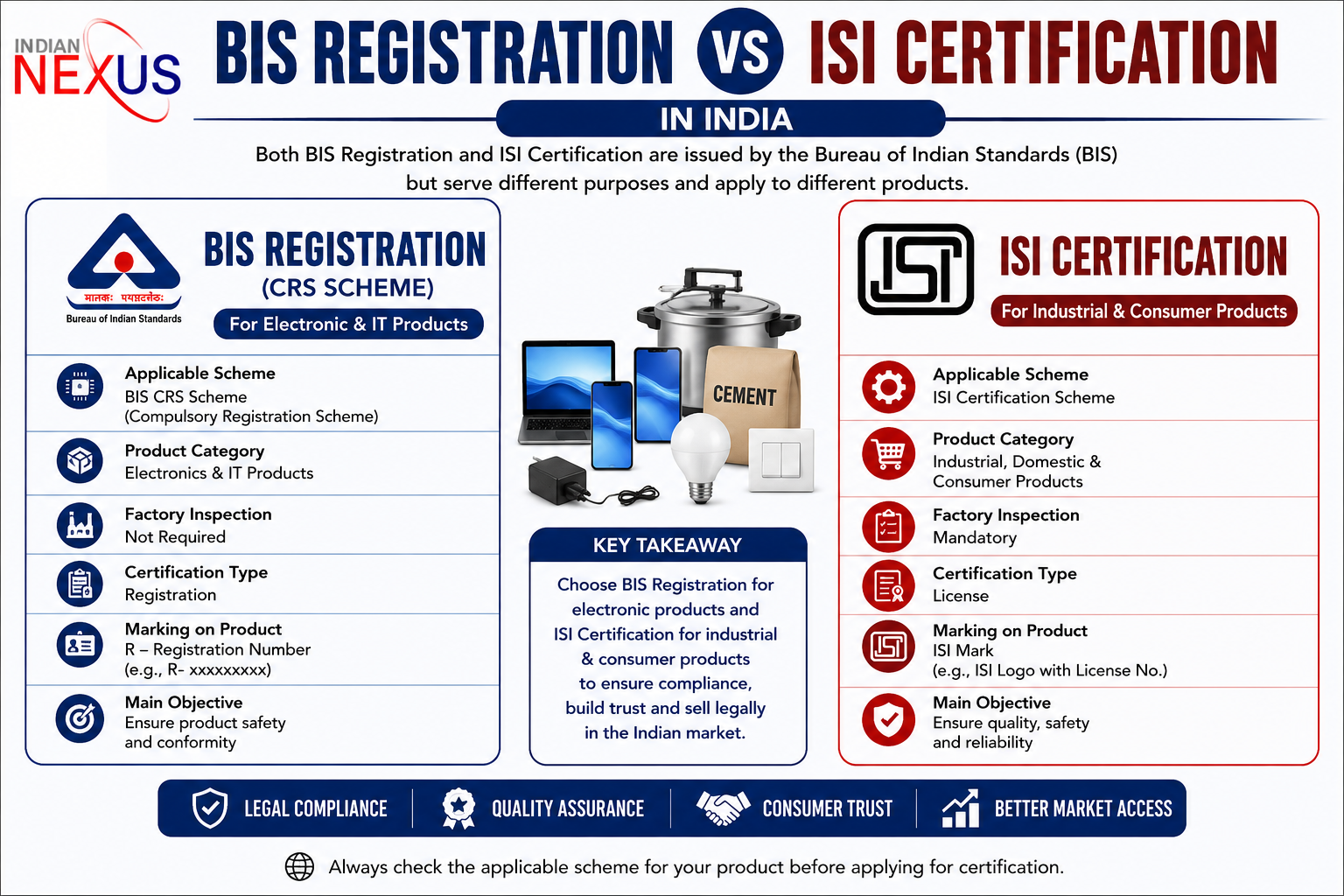
BIS Registration vs ISI Certification in India: Major Differences
Understanding BIS Registration vs ISI Certification in India is important for selecting the correct compliance route.
These differences clearly explain why businesses must evaluate their product category before applying.
Why BIS Compliance is Important
Whether obtaining BIS Registration vs ISI Certification in India, compliance provides several advantages:
Legal market access
Enhanced product credibility
Consumer confidence
Reduced regulatory risks
Better business reputation
Improved product quality
Today, BIS Compliance India has become a critical requirement for domestic and foreign manufacturers.
Products Covered Under BIS Registration
Products requiring Mandatory BIS Registration include:
LED lights
Mobile phones
Power banks
Laptops
Smart watches
Television sets
Printers
Electronic accessories
Manufacturers must obtain BIS CRS Registration before introducing these products into the Indian market.
Products Covered Under ISI Certification
Products requiring ISI Mark Certification include:
Cement products
Electric switches
Kitchen appliance
Pressure cooker
Steel bars
Drinking water systems
Household electrical equipment
An ISI Mark for Manufacturers indicates conformity with relevant Indian Standards.
Steps for BIS Registration
The BIS Approval Process generally includes:
Product testing
Technical documentation preparation
Online application submission
BIS scrutiny
Registration approval
Product marking authorization
This procedure enables businesses to achieve Product Certification India efficiently.
Steps for ISI Certification
The ISI certification process involves:
Product testing
Factory inspection
Quality system assessment
Application review
License grant
Ongoing surveillance audits
The process is more comprehensive compared to CRS registration.
Why Choose Professional Consultants?
Obtaining certifications independently can be challenging. A qualified BIS Registration Consultant or ISI Certification Consultant can help with:
Documentation preparation
Product testing coordination
Compliance assessment
BIS application filing
Follow-up with authorities
Faster approvals
Professional support minimizes delays and improves approval success rates.
Conclusion
It's critical that manufacturers, importers, and firms aspiring to make an impact on the Indian market understand the distinction between BIS Registration and ISI Certification in India. If BIS CRS Registration has limited applicability - mostly for electronics and IT goods, ISI Certification Mark, on the other hand, covers a vast arena of industrial and consumer items. Making a conscious choice of the desired certification path for your goods allows compliance with norms, security assurance, and consumer trust.
If your company needs to understand BIS Registration vs. ISI Certification in India, working with compliance experts might make life so much easier - and faster!
FAQs
1. What is the main difference between BIS Registration and ISI Certification?
BIS is primarily for electronic items under the CRS scheme and ISI is for products which need the ISI mark.
2. Is BIS Registration mandatory in India?
No! Several electronic devices need Mandatory BIS Registration for legal sale in India.
3. What is an ISI Mark License?
It is a license given by "Bureau of Indian Standards" where the manufacturers can put the ISI mark on certified goods.
4. Does BIS Registration require factory inspection?
Factory inspection is not a prerequisite in the case of CRS registration ascertained normally, whereas ISI certification entails a factory inspection.
5. How long does the BIS Approval Process take?
Product testing and documentation are upon the times there also depends on the review of BIS.
6. Can foreign manufacturers apply for BIS certification?
Yes, BIS can be sought for new products by manufacturers from India as well as other countries.
7. Why should I hire a BIS Registration Consultant?
A consultant helps administer documentation, testing, application filing, and no fuss during compliance.