






The lighting industry in India is undergoing a major transformation with the introduction of revised standards for LED luminaires by the Bureau of Indian Standards (BIS). These updates aim to improve safety, performance, energy efficiency, and compliance requirements for manufacturers and importers operating under the Compulsory Registration Scheme (CRS).
This blog provides a detailed overview of the new revised standards for LED luminaires, key technical changes, implementation timelines, and what businesses must do to stay compliant.
Overview of Revised LED Luminaire Standards
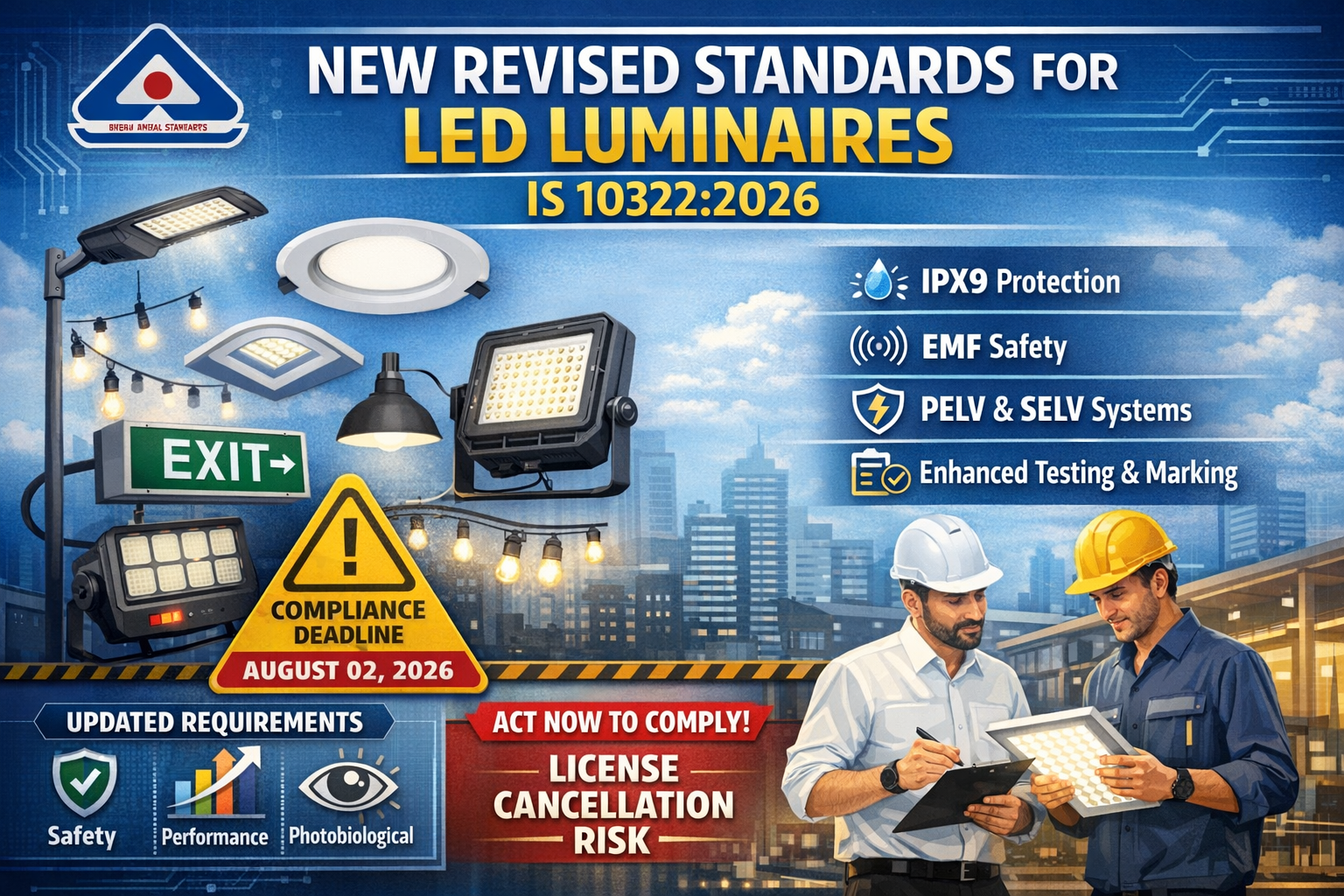
The BIS has updated the widely used IS 10322 series, specifically revising IS 10322 (Part 1):2014 to IS 10322 (Part 1):2026. This revision impacts several LED luminaire categories including:
Fixed General Purpose LED Luminaires
Recessed LED Luminaires
Street Lighting LED Luminaires
LED Flood Lights
LED Hand Lamps
LED Lighting Chains
Emergency LED Luminaires
All these categories are now aligned with the updated 2026 version of IS standards, ensuring harmonization with global IEC standards.
Key Deadline: Compliance Timeline
One of the most important aspects of the revised standards is the implementation deadline:
Last date of concurrent running: 02 August 2026
This means manufacturers can continue using old standards temporarily, but after this date, compliance with revised standards becomes mandatory.
Failure to comply may result in:
Cancellation of BIS license
Removal of product models from certification scope
Inability to sell products in the Indian market
Major Technical Changes in IS 10322 (Part 1):2026
The revised standards introduce several critical technical updates aimed at enhancing safety and performance:
1. Introduction of IPX9 Protection
LED luminaires must now meet higher ingress protection levels, especially IPX9, ensuring resistance to high-pressure water jets—important for industrial and outdoor lighting.
2. EMF Safety Requirements
New provisions address electromagnetic field (EMF) exposure, ensuring user safety in environments with prolonged lighting use.
3. Enhanced Marking Requirements
Manufacturers must now include more detailed product labeling, improving traceability and consumer awareness.
4. Protection Against Electric Shock
Updated testing methods now include:
Touch voltage limits
Touch current limits
These changes significantly improve user safety standards.
5. PELV and SELV System Integration
The inclusion of Protective Extra-Low Voltage (PELV) and Safety Extra-Low Voltage (SELV) systems ensures safer electrical design in luminaires.
6. Protection from Mechanical Hazards
A new clause introduces safety measures against fast rotating parts, such as fan-integrated luminaires.
7. Battery and EDLC Requirements
Specific provisions have been added for:
Battery-operated luminaires
Electric Double Layer Capacitors (EDLCs)
This is especially relevant for emergency lighting systems.
8. Photobiological Safety Expansion
The scope of photobiological safety has been extended to minimize harmful light exposure risks.
Category-Specific Changes
In addition to general updates, each luminaire category has undergone specific revisions:
Fixed General Purpose Luminaires
Updated scope to include all electric light sources
Alignment with revised Part 1 standards
Recessed Luminaires
New requirements for air-handling luminaires
Additional marking guidelines
Street Lighting Luminaires
Improved marking and compliance requirements
LED Flood Lights
Introduction of glass breaking test
Enhanced durability standards
LED Lighting Chains
New provisions for Temporarily Installed Protected Lighting (TPL)
Updated terminology and definitions
Emergency Luminaires
New requirements for lithium batteries
Improved testing for high-temperature operations
Enhanced visibility standards for exit signs
Guidelines for Existing Licensees
Manufacturers already holding BIS licenses must take the following steps:
Upgrade to Revised Standards
Ensure all products comply with IS 10322:2026 before the deadline.Submit Test Reports
Provide updated test reports from BIS-recognized laboratories.Declaration for Existing Models
Submit an undertaking confirming compliance for all product variants.Avoid Delays
Non-compliance after 02 August 2026 may lead to license cancellation.
Guidelines for New Applicants
For businesses applying for BIS registration:
Applications submitted before the deadline can use old standards temporarily.
A declaration must be provided to transition to revised standards before the deadline.
After 02 August 2026, only revised standards will be accepted.
Impact on Manufacturers and Importers
The revised standards bring both challenges and opportunities:
Challenges
Cost of re-testing and certification
Design modifications for compliance
Documentation and labeling updates
Opportunities
Improved product quality and safety
Better acceptance in global markets
Increased consumer trust
Importance of BIS Compliance
Compliance with BIS standards is not just a legal requirement but also a mark of quality. The Bureau of Indian Standards plays a crucial role in ensuring that lighting products in India meet global benchmarks.
Non-compliance can lead to:
Legal penalties
Market restrictions
Loss of brand reputation
How a Consultant Can Help
Navigating revised standards can be complex. A professional BIS consultant can assist with:
Gap analysis between old and new standards
Product testing coordination
Documentation and application filing
Ensuring timely compliance
This is especially beneficial for manufacturers dealing with multiple product categories.
Conclusion
The new revised standards for LED luminaires (IS 10322:2026) mark a significant step toward safer, more efficient, and globally aligned lighting solutions in India. With enhanced safety requirements, stricter testing protocols, and updated compliance guidelines, businesses must act proactively to meet the upcoming deadline of 02 August 2026.
Manufacturers and importers should start the transition process immediately to avoid disruptions and ensure continued market access. Partnering with an experienced consultant can make this transition smooth and efficient.
Staying compliant not only ensures regulatory approval but also strengthens your brand’s credibility in the competitive lighting industry.