








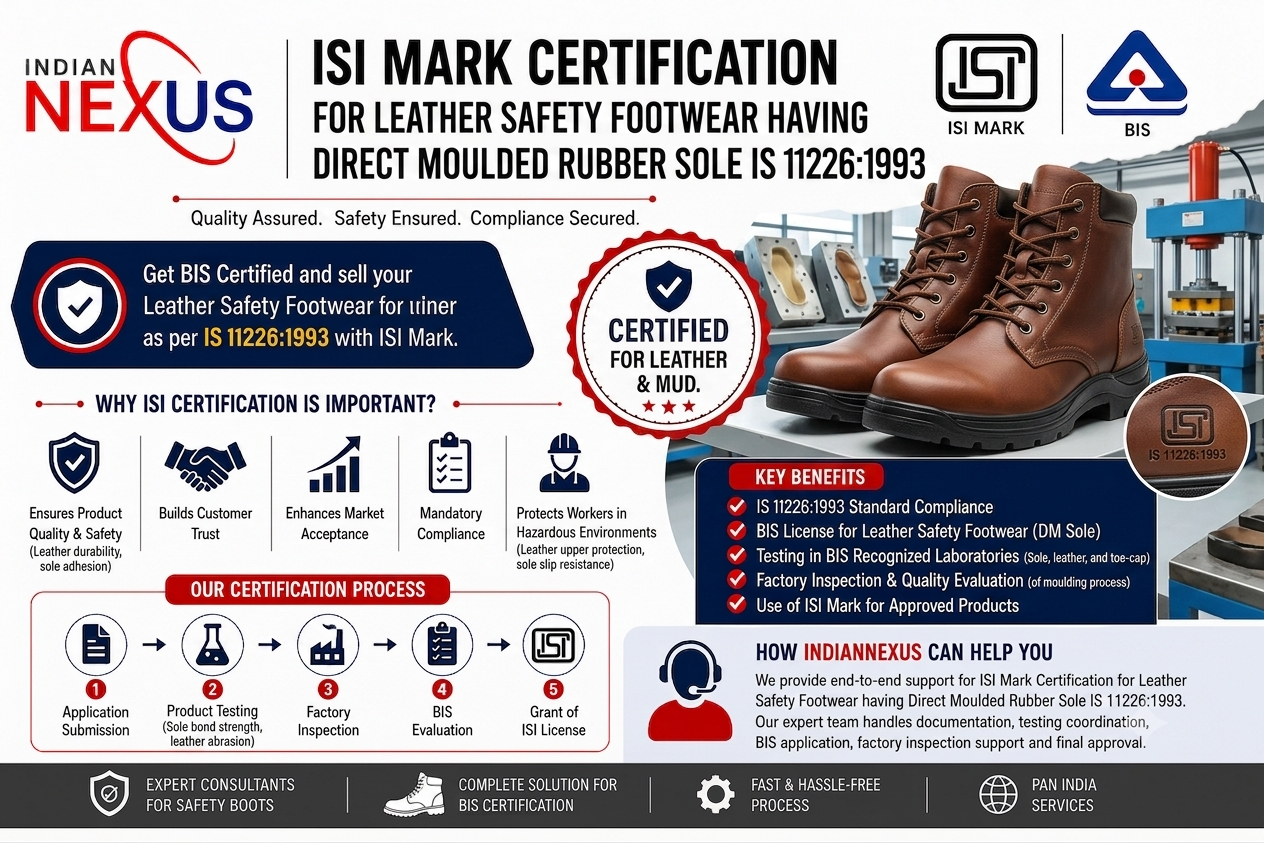
All manufacturers of industrial safety footwear need to have their products comply with the appropriate Indian Standards before releasing their product in the market. ISI mark for Leather Safety Footwear Having Direct Moulded Rubber Sole IS 11226:1993 Indian Standard ISI mark certification is a necessary quality certification proving that footwear conforms to the Bureau of Indian Standards (BIS) on the safety, quality, and strength aspect of footwear.
ISI Mark Certification for Leather Safety Footwear Having Direct Moulded Rubber Sole IS 11226:1993 This marks an indication that safety footwear meets stringent quality testing and quality standards that are specified as part of the ISI mark scheme for all construction sites, mines, factories, engineering units, and industrial places. The companies manufacturing safety footwear would need ISI mark certification for their shoes as safety shoes are essential to protect workers from various types of industrial injuries.
Importance of IS 11226:1993 Certification
The IS 11226:1993 Certification is a standard for quality requirements in leather safety footwear that incorporates directly injected rubber soling systems. Such products provide footwear that offers both a workplace safety element along with lasting and comfortability.
Gaining the ISI Mark for Leather Safety Footwear helps ensure the quality of product for the manufacture and workplace safety. Moreover it adds support in gaining customers’ trust and increases acceptability of the business.
The ISI Mark Certification for Leather Safety Footwear Having Direct Moulded Rubber Sole IS 11226:1993 is a crucial certification that ensures quality standards are being maintained by the manufacturing units.
Benefits of BIS Certification
The BIS Certification for Leather Safety Shoes provides several advantages:
Enhanced product credibility
Compliance with BIS regulations
Improved customer confidence
Better market competitiveness
Eligibility for government tenders
Consistent product quality
Reduced risk of regulatory action
The Direct Moulded Rubber Sole Footwear Certification confirms that the footwear can withstand demanding industrial conditions and provide effective protection to users.
Certification Process
The process for obtaining ISI Mark Certification for Leather Safety Footwear Having Direct Moulded Rubber Sole IS 11226:1993 generally includes:
1. Application Submission
Manufacturers submit an application to BIS along with technical documents and product specifications.
2. Product Testing
Each Sample is Tested inBIS-Certified Laboratory to conform with IS 11226: 1993 Compliance requirements.
3. Factory Inspection
BIS officials conduct a factory audit to assess manufacturing processes and quality control systems.
4. Review and Approval
Upon successful evaluation BIS awards ISI mark license for Leather Safety Footwear.
5. Ongoing Surveillance
Continuous monitoring for ongoing adherence to standards of quality and the quality of the product.
Documents Required
Manufacturers typically need:
Business registration documents
Factory license
Manufacturing process details
Quality control records
Product specifications
Testing reports
Authorized signatory documents
These documents help support the BIS License for Safety Footwear application process.
Why Choose Indiannexus?
We can help with the ISI mark for Leather Safety Footwear Having Direct Moulded Rubber Sole IS 11226:1993, our professionals provide documentation assistance, testing coordination support, preparing your facility for factory inspection and also for managing your BIS application process.
Leveraging the extensive compliance know-how, Indiannexus assists companies in securing the BIS approval for leather safety footwear in the fastest way, reducing the overall risk of non-compliance.
For manufacturers, we have comprehensive Safety Footwear Certification India solutions and can simplify your process for certification.
Conclusion
The Importance of Getting ISI Mark Certification for Leather Safety Footwear Having Direct Moulded Rubber Sole IS 11226:1993 certification means that the manufacturer complies with legal guidelines and meets quality standards, builds customer confidence and boosts business.
Even if you are a start-up in the manufacturing industry or already a leading brand of footwear, the ISI mark for Leather Safety Footwear Having Direct Moulded Rubber Sole IS 11226:1993 will prove to be very beneficial and increase your scope for business. This process can be done more easily if you have experienced consultants working with you on the matter.
FAQs
1. Leather Safety Shoes having Direct moulded Rubber Sole IS 11226: 1993 with ISI Certification What it is all about?
The BIS certification regarding quality of Leather Safety Footwear comes under IS 11226:1993 which specifies the safety and quality requirements.
2.Is 11226:1993 Certification Mandatory?
If your products are covered under mandatory certification then the following BIS specifications should be met.
3.Key Aspects Of The Standard (IS 11226:1993)
The Indian standard lays out the quality requisites, the safety procedures, construction process, testing process and general performance standards for direct moulded rubber-sole leather safety footwear.
4. How long does the certification process take?
The total duration of the ISI certification process can vary as it depends on documentation, factory inspection, testing, and the approval process at BIS.
5. What is the Function of BIS in the Certification Process?
BIS assesses products, performs inspections, and issues an ISI license upon confirmation of adherence to all stipulated criteria.
6. What is the Need for Testing the Products?
Product testing is performed to certify that the products meet the safety and performance specifications as mentioned in the standard.
7. Can Consultants Help in the Certification process?
Professional consultants can guide the manufacturers with documentation, coordination for testing, application filing, and compliance management.