






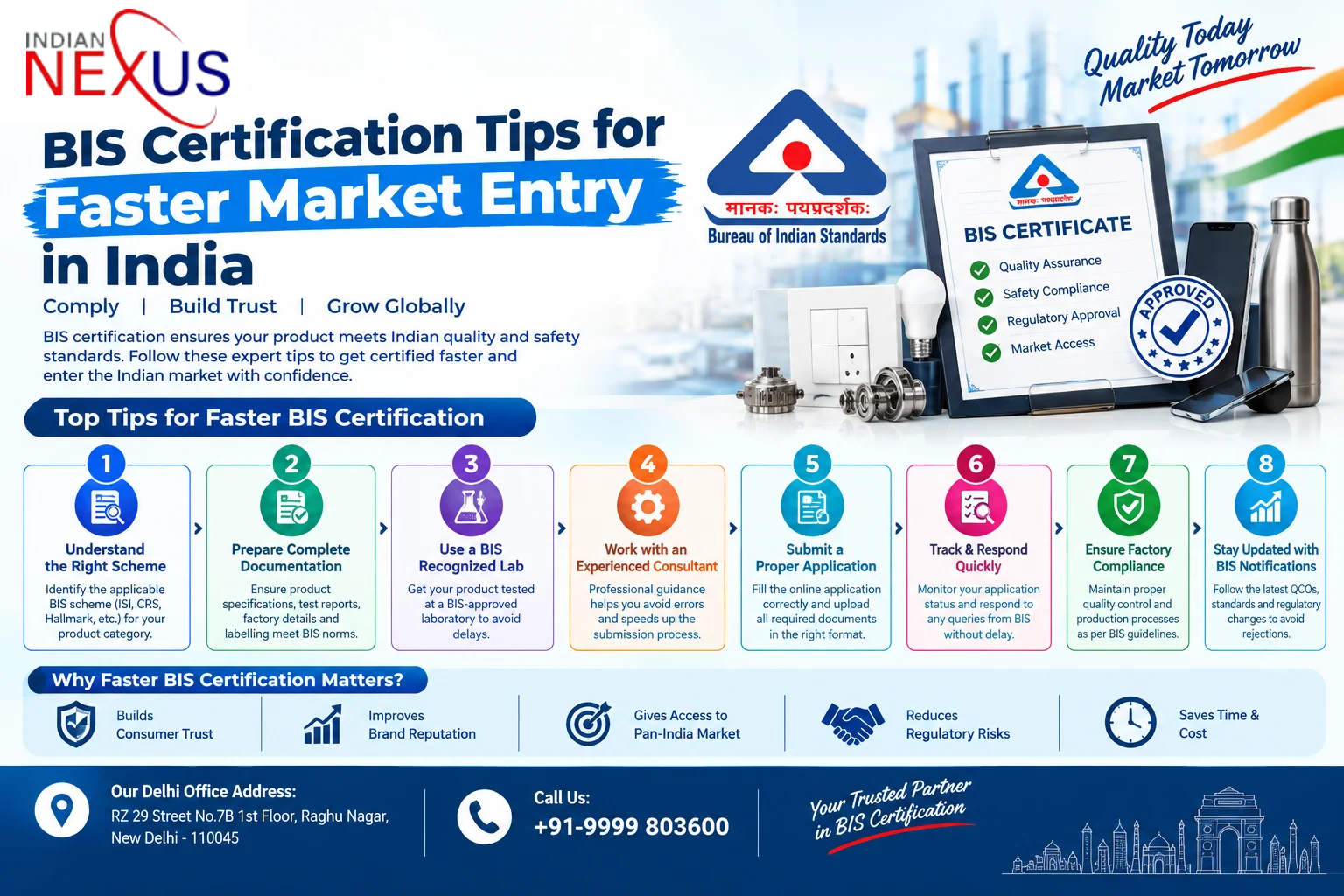

ISI Certification and Registration is one of the most important compliance requirements for manufacturers in India who want to sell products that come under the Bureau of Indian Standards (BIS) mandatory product list. The ISI mark stands for “Indian Standards Institute”, which is now governed by BIS, and it serves as a symbol of quality, safety, and reliability. When a product carries the ISI Mark, it assures consumers that the product has been thoroughly tested and meets the specific Indian Standard (IS) defined by BIS.
The primary objective of ISI Certification is to ensure that consumers receive safe, standardized, and high-quality products, while also helping manufacturers build brand credibility and comply with legal requirements in the Indian market.
What is ISI Certification?
ISI Certification is a conformity assessment scheme that requires manufacturers to have their products tested in BIS-recognized laboratories to verify compliance with Indian standards. Only after meeting all technical parameters and safety norms can a manufacturer affix the ISI Mark on the product.
Some of the widely used products that require mandatory ISI Certification and Registration include:
Electrical appliances such as switches, wires, and motors
Cement and steel products
LPG cylinders and valves
Helmets, automotive components
Household goods like pressure cookers
Water purifiers, LED lights, and more
If a product is included in the BIS compulsory certification scheme, selling it without the ISI mark can attract penalties, product recall, or discontinuation of sales.
Why is ISI Certification Important?
Legal Compliance:
For many product categories, ISI Certification is mandatory under various government notifications.Consumer Trust:
The ISI mark assures customers that the product is safe, durable, and manufactured using approved processes.Market Access:
Without ISI Registration, manufacturers may not be allowed to sell in the Indian market, especially in government procurements.Brand Reputation:
Products with ISI Certification have stronger goodwill and consumer preference.Improved Quality Control:
The certification process enhances internal manufacturing discipline and product reliability.
ISI Certification and Registration Process
The ISI Certification process involves multiple technical, documentation, and inspection stages. Below is a step-by-step overview of how manufacturers can obtain the ISI mark:
1. Identify Applicable Indian Standards (IS)
The first step is to determine which Indian Standard applies to your product. Every product category has a unique IS code.
2. Factory Audit and Documentation
BIS appoints an auditor to inspect the factory infrastructure, testing capabilities, production process, raw materials, and quality system.
3. Product Testing in BIS-Recognized Lab
Samples of the product are collected and tested in BIS-approved laboratories. The product must comply with all performance, durability, and safety parameters.
4. Submission of BIS Application
All required documents, including test reports, factory inspection reports, technical files, and company details, are submitted to BIS for evaluation.
5. Grant of ISI License
Once the test results and audit findings meet the BIS criteria, the license is granted. The manufacturer can now affix the ISI mark on every product unit manufactured at the registered location.
Key Documents Required for ISI Certification
Factory license
Manufacturing layout and process flow
ISO certification (if applicable)
Raw material details
In-house testing facilities information
Product test reports
Trademark registration (optional but beneficial)
Validity and Renewal of ISI License
The ISI Certification is typically valid for two years, after which it must be renewed. Renewal is easier than the initial certification as long as the manufacturer maintains quality standards and submits updated compliance documents.
Penalties for Non-Compliance
Manufacturing or selling a product covered under the mandatory BIS scheme without ISI Certification can lead to:
Monetary fines
Product seizure or recall
License cancellation
Legal action under the BIS Act, 2016
Therefore, timely registration and renewal are essential for smooth business operations.