








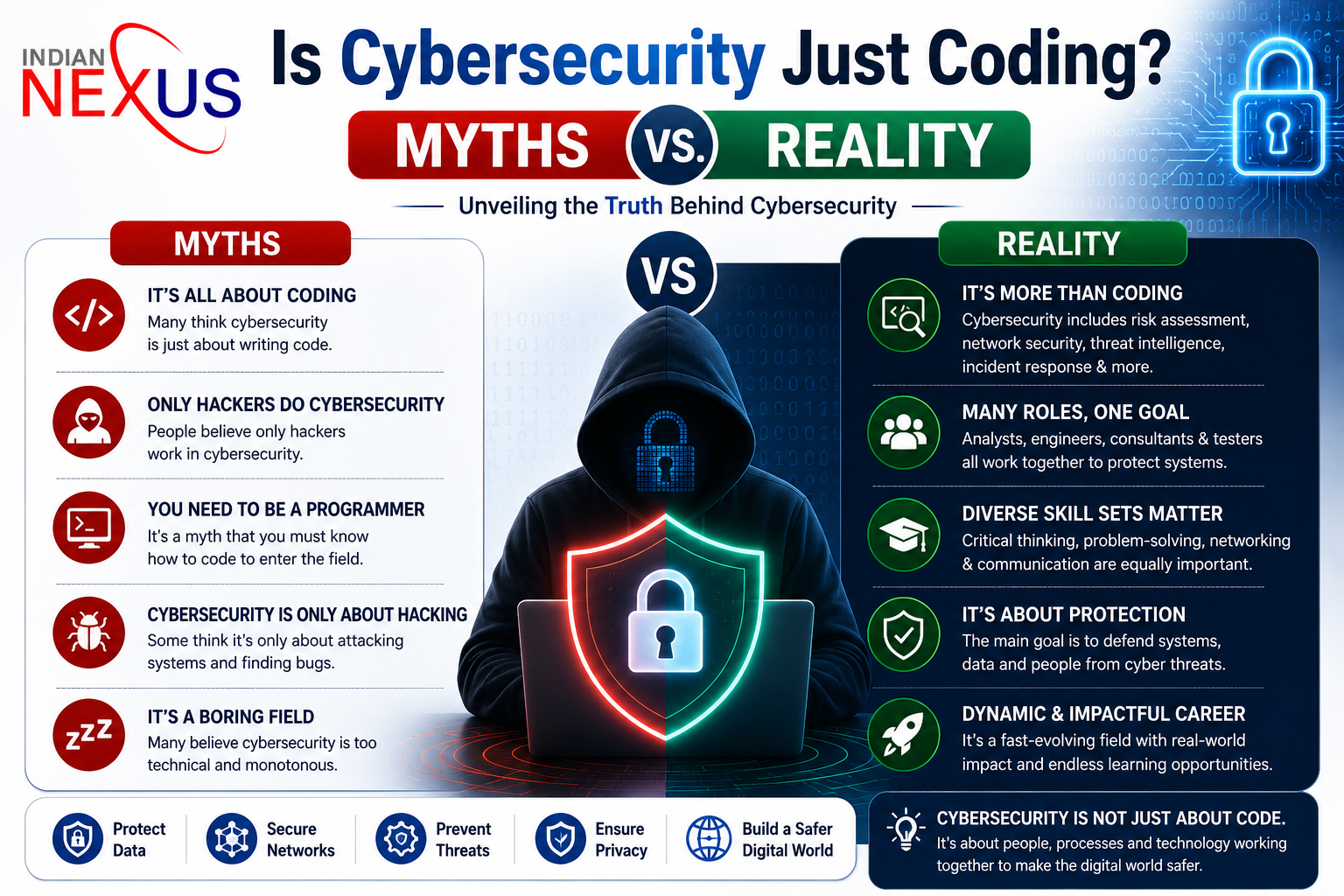
For the majority of individuals cybersecurity is believed to only target developers or programmers which causes students/career changes away from one of the quickest growing sectors of tech and the most important. Often many question is cybersecurity just coding? Myths vs. Reality because it seems like there's so many more pieces of this complex industry to Cybersecurity than simply coding which many have feared in their whole career/ schooling life.
At Indiannexus, we regularly interact with aspiring professionals who assume that extensive programming knowledge is mandatory for entering the cybersecurity field. Although there may be jobs in Cybersecurity that utilize coding, a number of jobs available rely on risk analysis, security monitoring, compliance and regulations, and incident response, management, and strategy, not software coding.
Understanding Is cybersecurity just coding? Myths vs. Reality helps individuals make informed career decisions and discover opportunities that match their strengths and interests.
Understanding Cybersecurity Beyond Coding
Cybersecurity can be simply defined as the measures taken by the organizations to protect, defend, and secure all systems, devices, networks, and sensitive data, and so on from all online attacks. It involves the usage of many different technologies and approaches that together will be employed to guard against several cyber-threats.
The cybersecurity myth and fact for the number one debate topic is coding skills. Many may use codes and computer programming languages to solve issues, or automate certain things. Yet a majority do not need to code to manage threats, maintain networks, monitor overall compliance or to implement any of the defenses needed to secure a business.
This clearly demonstrates the reality behind Is cybersecurity just coding? Myths vs. Reality.
Cybersecurity vs Coding: What's the Difference?
The discussion around Cybersecurity vs Coding often creates confusion.
In coding: is an activity associated with the development of computer software. In cybersecurity: the practice of protecting systems, networks, and program from digital attacks.
Software develops apps while cybersecurity protects apps from becoming exploitable and vulnerable.
Regarding Does Cybersecurity Necessitate Coding? Myths vs. Realities, code is a minuscule part of a far bigger picture of how things are kept safe in the cyber world.
Cybersecurity Skills Required for Success
The diverse nature of many jobs within cybersecurity draws in all types of people.
Important Cybersecurity Skills Required include:
Risk assessment
Security monitoring
Threat intelligence
Incident response
Communication skills
Problem-solving abilities
Compliance management
Network analysis
Data Protection and Security knowledge
Security policy implementation
These skills show why Is cybersecurity just coding? Myths vs. Reality remains an important discussion for aspiring professionals.
Cybersecurity Without Coding: A Real Possibility
Many entry-level cybersecurity positions require little or no programming experience. Roles such as:
Security Analyst Career positions
Compliance Auditor
Governance and Risk Specialist
Security Operations Center Analyst
Information Security Consultant
Cybersecurity Awareness Trainer
demonstrate the growing demand for Cybersecurity Without Coding opportunities.
Understanding Is cybersecurity just coding? Myths vs. Reality allows beginners to recognize that coding is not the only pathway into cybersecurity.
Growing Demand for Information Security Solutions
Organizations worldwide are investing heavily in Information Security Solutions and Digital Security Solutions to protect sensitive information.
Businesses need experts who can:
Manage security policies
Monitor threats
Conduct risk assessments
Improve Data Protection and Security
Support Cyber Threat Prevention
Maintain regulatory compliance
These kinds of responsibilities usually involve a higher degree ofanalytical skillthan actual programming skill.
This further supports the reality behind Is cybersecurity just coding? Myths vs. Reality.
Career Opportunities in Cybersecurity
A comprehensive Cybersecurity Career Guide reveals numerous career paths:
Security Analyst Career
Threat Intelligence Analyst
Risk Management Specialist
Security Consultant
Ethical Hacking Services Expert
Compliance Officer
Security Operations Specialist
Network Security Management Professional
That there are even these kinds of different roles demonstrates is cybersecurity solely a case of writing code-or not-is a topic that warrants investigation prior to committing.
Modern Cybersecurity Practices
The majority of the organisations are using very modern and advanced security architectures and technologies in present days in order to safeguard their digital assets.
Key Modern Cybersecurity Practices include:
Multi-factor authentication
Vulnerability management
Security monitoring
Cloud security
Endpoint protection
Threat detection
Incident response planning
Employee Cybersecurity Awareness programs
Professionals implementing these practices often work with security tools rather than writing extensive code.
This highlights another aspect of Is cybersecurity just coding? Myths vs. Reality.
Why Cybersecurity for Beginners Is Accessible
There are many learning opportunities from industry, including Cybersecurity Training, certification, and hands-on labs.
For Cybersecurity for Beginners, foundational knowledge typically includes:
Networking concepts
Operating systems
Security principles
Threat management
Basic security tools
Specialisation is also possible when a person gains experience in a specific area and naturally drifts into a career based on a passion or strength.
Coding vs Cybersecurity – myth & reality An interesting guide to getting started for the uninitiated on the true nature of cybersecurity.
Conclusion
The answer to whether cybersecurity is merely coding is no – it’s an intricate and multifaceted field far exceeding rote programming skills. While coding ability serves as an asset for specific job functions, a significant portion of cybersecurity work is rooted in strategic planning, insightful analysis, attentive monitoring, legislative compliance and astute risk management.
As companies grow their reliance on IT Security Services, Cyber Threat Prevention, Network Security Management, Information Security Solutions and much more. Cybersecurity careers offer fantastic job possibilities, especially in today’s world when the number of threats is rapidly increasing, impacting businesses around the globe. You can find numerous cybersecurity career paths with diverse qualifications needed
Frequently Asked Questions (FAQs)
1. Cybersecurity: All Code, All The Time?
Nope. Risk management, compliance, threat intel, security monitoring, the list goes on and ON without writing a single line of code.
2.Bouncing into cybersecurity without the code?
They’re all about the networks, the basic security know-how and analytical brainpower.
3. Top Gun cyber skills?
Those are your risk assessment Ninjas, your communication Wizards, the threat detection and problem-solving superheroes!
4. Ready to cyber rookie-up?
Enroll in cybersecurity bootcamps, pick up a couple of certs, screw around in some of those online labs, and pick up some of the basics of networking.
5. Cybersecurity boom going bust?
Nah! Every company from here to Timbuktu is digging deep into cybersecurity funds to fend off those ever-escalating digital dangers and the endless regulations.
6. Advanced math required?
Not really for 99.999% of cybersecurity roles, though a few nerds might do a little dabbling with analytics.