



For the firms working in electronic goods, plastic packaging, batteries and similar types of regulated waste, the EPR Registration in India 2026: Cost, Documents, and Process, has become one of the mandatory compliance norms for them. The Indian government has imposed more rigor to enforce EPR norms in a productive manner.
To legally market and sell in the Indian market, all manufacturers, brand owners, importers, producers, and recyclers are obligated to meet EPR requirements. Without proper authorization, operating in India could lead to legal liabilities.
With Indianexus, your business gets end-to-end support with EPR registration, document creation, application submission and ongoing compliance post registration.
What is EPR Registration?
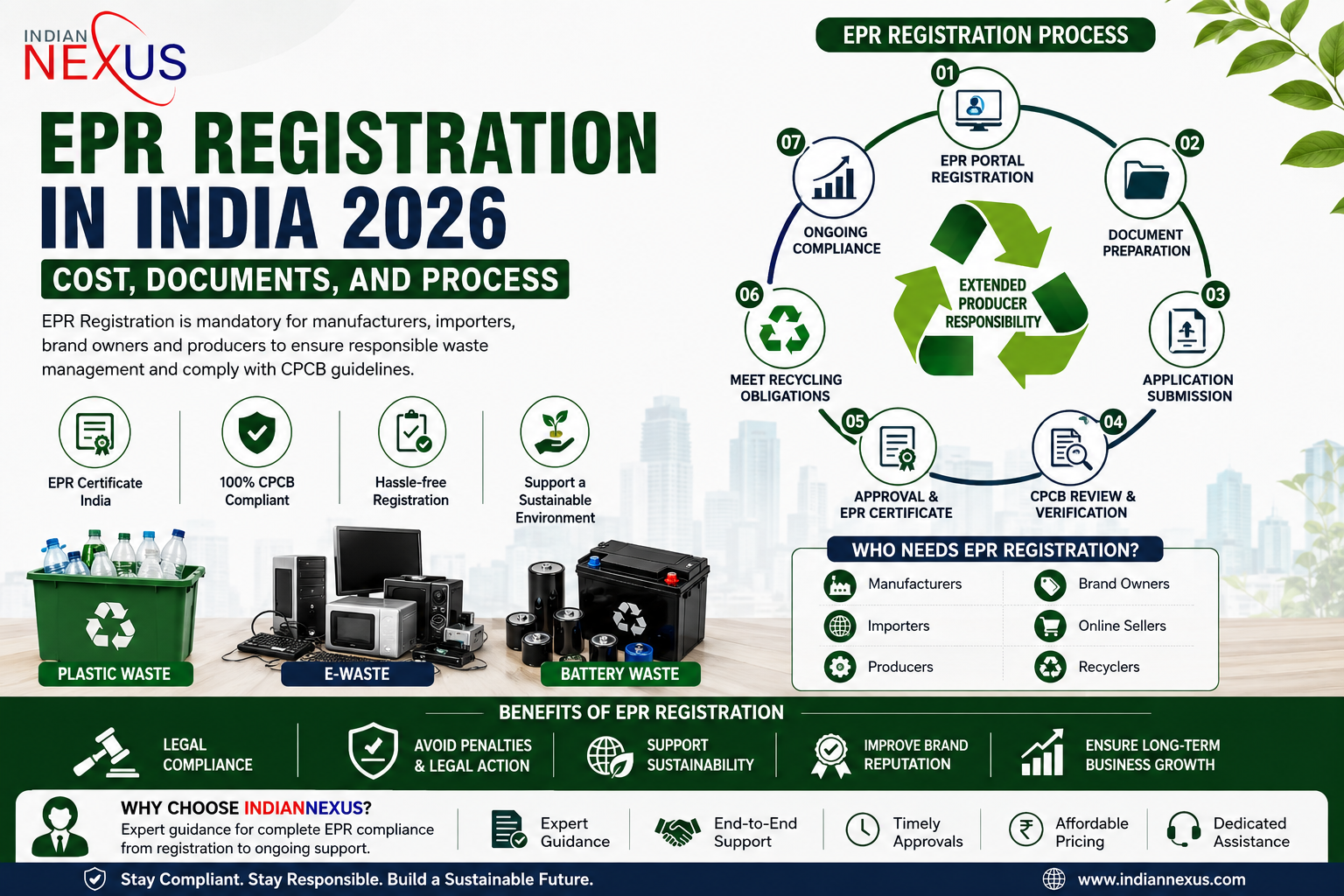
An ERP - Extended Producer Responsibility, is a policy where extended producers are held accountable for the pickup, processing and environmentally sustainable waste of a product post expiration.
The EPR registrations are made on the CPCB portal by the Central Pollution Control Board. No producer of notified products will be allowed to circulate these products in India if they have not obtained the required registration.
The framework applies to:
Electronic equipment manufacturers
Plastic packaging producers
Battery manufacturers
Importers of regulated products
Brand owners
Producers and recyclers
Getting an EPR Certificate India allows businesses to be more environmentally responsible and compliant at the same time.
Who Needs EPR Registration in India?
Several business categories require CPCB EPR Registration:
Producers
Companies manufacturing products covered under EPR regulations.
Importers
Organizations importing electronics, batteries, plastic-packaged products, or related items into India.
Brand Owners
Businesses selling products under their own brand names.
Recyclers
Authorized entities involved in recycling regulated waste streams.
Manufacturers
Organizations producing components or finished goods covered by EPR Rules 2026.
Documents Required for EPR Registration
One of the most common questions businesses ask relates to EPR Registration Documents Required.
Typical documentation includes:
Company PAN Card
GST Registration Certificate
Incorporation Certificate
IEC Certificate
Authorized Signatory Details
Product Details
Brand Information
Sales Responsibility Environmental Awareness
Import Data
Waste Management Plan
Recycling Agreements
Factory License (if applicable)
Address Proof
The exact documentation may vary depending on whether the application relates to E-Waste EPR Registration, Plastic Waste EPR Registration, or Battery Waste EPR Registration.
EPR Registration Process India
The application procedure has become more structured under recent regulatory updates.
Step 1: Business Assessment
Experts evaluate the product category and determine applicable EPR obligations.
Step 2: Documentation Preparation
All supporting documents are collected, verified, and organized.
Step 3: CPCB Portal Registration
The applicant creates an account through the EPR Portal Registration system.
Step 4: Application Filing
Relevant forms and compliance information are submitted.
Step 5: Document Verification
Authorities review the application and supporting records.
Step 6: Clarification and Response
Additional information may be requested by CPCB officials.
Step 7: Approval and Certificate
Upon successful review, the EPR Certificate India is issued.
Businesses seeking EPR Registration in India 2026: Cost, Documents, and Process should ensure that all submitted information is accurate to avoid delays.
EPR Registration Cost 2026
The EPR Registration Fees India depend on multiple factors:
Type of waste category
Product volume
Annual turnover
Scope of compliance
Recycling targets
CPCB fee structure
Consultant support requirements
There is no single fixed fee applicable to all businesses. Costs vary significantly depending on the category and business operations.
Professional EPR Registration Consultant India services can help reduce errors and prevent costly delays during approval.
Benefits of EPR Compliance
Obtaining EPR Authorization India offers several advantages:
Legal Compliance
Meet regulatory obligations under environmental laws.
Market Access
Continue selling products without compliance interruptions.
Brand Reputation
Show your sustainability efforts.
Risk Reduction
Prevent compliance violations and the resulting fines!
Improved Waste Management
Support responsible recycling and resource recovery.
Business Growth
Building trust takes work, with customers and distributors, of course, but also with your stakeholders.
Environmental Responsibility
The ability to have a greener future, is in our hands.
Why Choose Indiannexus?
Indiannexus provides end-to-end assistance for:
EPR Application Process
EPR Portal Registration
Documentation support
CPCB filings
Compliance planning
Annual return support
Ongoing EPR Compliance 2026 management
Businesses get approvals more quickly, streamline compliance management with the help of expert consultants and know-how in the field.
Conclusion
The blog post "EPR Registration in India 2026: Cost, Documents, and Process" is useful for those manufacturers, importers, producers, and brand owners in the relevant regulatory industries. Complete documentation and timely filing will enable smooth approvals for all. If you need to register for Plastic Waste EPR Registration, Battery Waste EPR Registration or E-Waste EPR Registration, you will benefit from our expert guidance and timely regulatory compliance, for all years to come. Get in touch with Indiannexus today to complete EPR registration with ease.
FAQs
1. What is EPR Registration in India?
EPR Registration is mandatory authorization issued to producers, importers and brand owners for regulated waste categories.
2. Who issues EPR Certificates in India?
The CPCB provides EPR approvals 2001 from its online portal.
3. Is EPR Registration mandatory for importers?
Importer(s) of the applicable products are required to seek EPR authorization to sell the products in India.
4. How long does EPR registration take?
The timeline depends on completness ofdocuments, correctness of application and time taken for review by CPCB.
5. What documents are required for EPR registration?
Essential documentation to be collected will comprise: PAN, GST, IEC, company incorporation documents, Description(s) of product, Recycling plan.
6. What is the cost of EPR registration in 2026?
The price depends on the product catergory, type of waste and regulatory requirements.
7. Can consultants help with EPR registration?
Yes, sending everything to the professional consultants who then help with all documentation, filing, managing the compliances, getting approvals etc.