








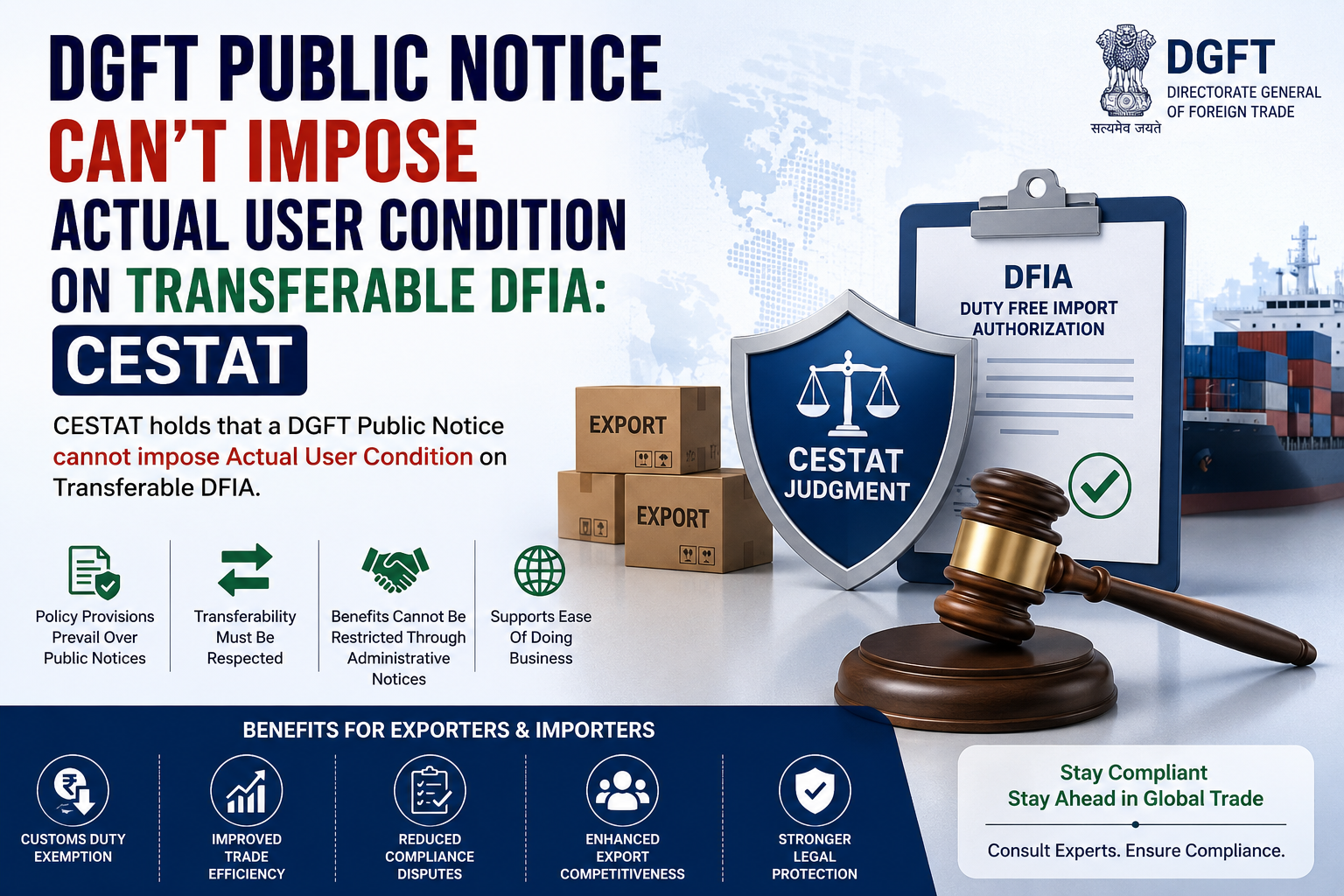
DGFT Public Notice Can't Impose Actual User Condition on Transferable DFIA: CESTAT Rules In a much-welcomed development for importers, exporters, and holders of Duty Free Import Authorisation (DFIA) countrywide, a recent CESTAT (Customs, Excise and Service Tax Appellate Tribunal) ruling on DGFT Public Notice dated [Public Notice Number and Date], clearly elucidates that an Actual User Condition cannot be imposed on a transferable DFIA after it has been transferred.
At Indiannexus, we help businesses understand the implications of the DGFT Public Notice Can’t Impose Actual User Condition on Transferable DFIA: CESTAT decision and ensure complete compliance with import-export regulations.
Understanding the DFIA Scheme India
The DFIA Scheme India is a popular export promotion scheme that allows exporters to import inputs required for manufacturing export products without paying customs duty. The scheme is designed to improve competitiveness in global markets and support export growth.
One of the major advantages of DFIA is that it can become transferable after fulfillment of export obligations. The recent DGFT Public Notice Can’t Impose Actual User Condition on Transferable DFIA: CESTAT judgment confirms that transferable authorizations should remain freely transferable without additional restrictions.
What is the Actual User Condition?
The Actual User Condition requires imported goods to be used only by the authorization holder and prohibits transfer to third parties. Such conditions are common in certain import schemes to prevent misuse.
However, according to the DGFT Public Notice Can’t Impose Actual User Condition on Transferable DFIA: CESTAT ruling, once DFIA becomes transferable under applicable regulations, imposing an Actual User Condition contradicts the very nature of transferability.
This interpretation aligns with the principles of Foreign Trade Policy India and promotes ease of doing business.
Significance of the CESTAT Judgment
That significant CESTAT Judgment in question further stated that policy provisions/legislative provisions to the contrary on account of transferability could not be superseded.
No Actual User Condition can be Imposed in DGFT Public Notice on Transferable DFIA: CESTAT Holds
Transferable DFIA remains freely transferable.
Authorities cannot introduce new restrictions through public notices.
DFIA holders are entitled to policy benefits.
Trade facilitation objectives must be respected.
Importers receive greater legal certainty.
This CESTAT Ruling on DFIA serves as a crucial precedent for future disputes involving trade authorizations.
Benefits for Exporters and Importers
The DGFT Public Notice Can’t Impose Actual User Condition on Transferable DFIA: CESTAT decision offers several advantages:
Enhanced Flexibility
Businesses can transfer DFIA authorizations without concerns regarding additional user restrictions.
Improved Trade Efficiency
Companies can optimize procurement strategies under the Duty Free Import Authorization framework.
Reduced Litigation
The ruling minimizes interpretational disputes related to DFIA Transferability Rules.
Better Export Competitiveness
Exporters can maximize benefits available under Export Incentive Schemes India.
Stronger Legal Protection
The judgment provides clarity regarding Trade Policy Compliance requirements.
Importance of DGFT Regulations
Businesses engaged in imports and exports must remain updated with changing DGFT Regulations and DGFT Notification Updates. Regulatory interpretations can significantly impact customs benefits and operational planning.
The DGFT Public Notice Can’t Impose Actual User Condition on Transferable DFIA: CESTAT ruling reinforces the principle that trade benefits granted under policy cannot be restricted through procedural notices.
How Indiannexus Can Help
At Indiannexus, we provide comprehensive support for:
DFIA applications
Import Export License India assistance
DGFT compliance advisory
Export documentation
Customs compliance management
Trade policy consultation
DGFT Consultant Services
Regulatory representation
Our experts help businesses understand the impact of the DGFT Public Notice Can’t Impose Actual User Condition on Transferable DFIA: CESTAT judgment and implement effective compliance strategies.
Why Choose Indiannexus?
Experienced trade compliance professionals
Expertise in DFIA and export incentives
End-to-end DGFT support
Fast documentation assistance
Practical compliance solutions
Reliable regulatory guidance
The DGFT Public Notice Can’t Impose Actual User Condition on Transferable DFIA: CESTAT decision highlights the importance of proper interpretation of trade laws and reinforces confidence among exporters and importers.
FAQs
1. What is DFIA?
DFIA stands for Duty Free Import Authorization, an export incentive scheme allowing duty-free import of inputs.
2. What does transferable DFIA mean?
A transferable DFIA can be sold or transferred after fulfillment of export obligations.
3. What is the Actual User Condition?
It is a restriction requiring imported goods to be used only by the authorization holder.
4. What did the CESTAT ruling decide?
The tribunal held that a public notice cannot impose an Actual User Condition on a transferable DFIA.
5. Why is this judgment important?
In this article, the Foreign Trade Policy protection on the issue of transferability rights.
6. Who does this decision favor?
Exporters and importers; DFIA holders and all companies involved in foreign trade.
7. How can Indiannexus help?
Indiannexus offers DFIA advisory, DGFT compliance support, and customs consultation services.
8. Does the ruling affect customs duty exemptions?
Yes, it supports the proper utilization of customs duty exemption benefits under transferable DFIA authorizations.