





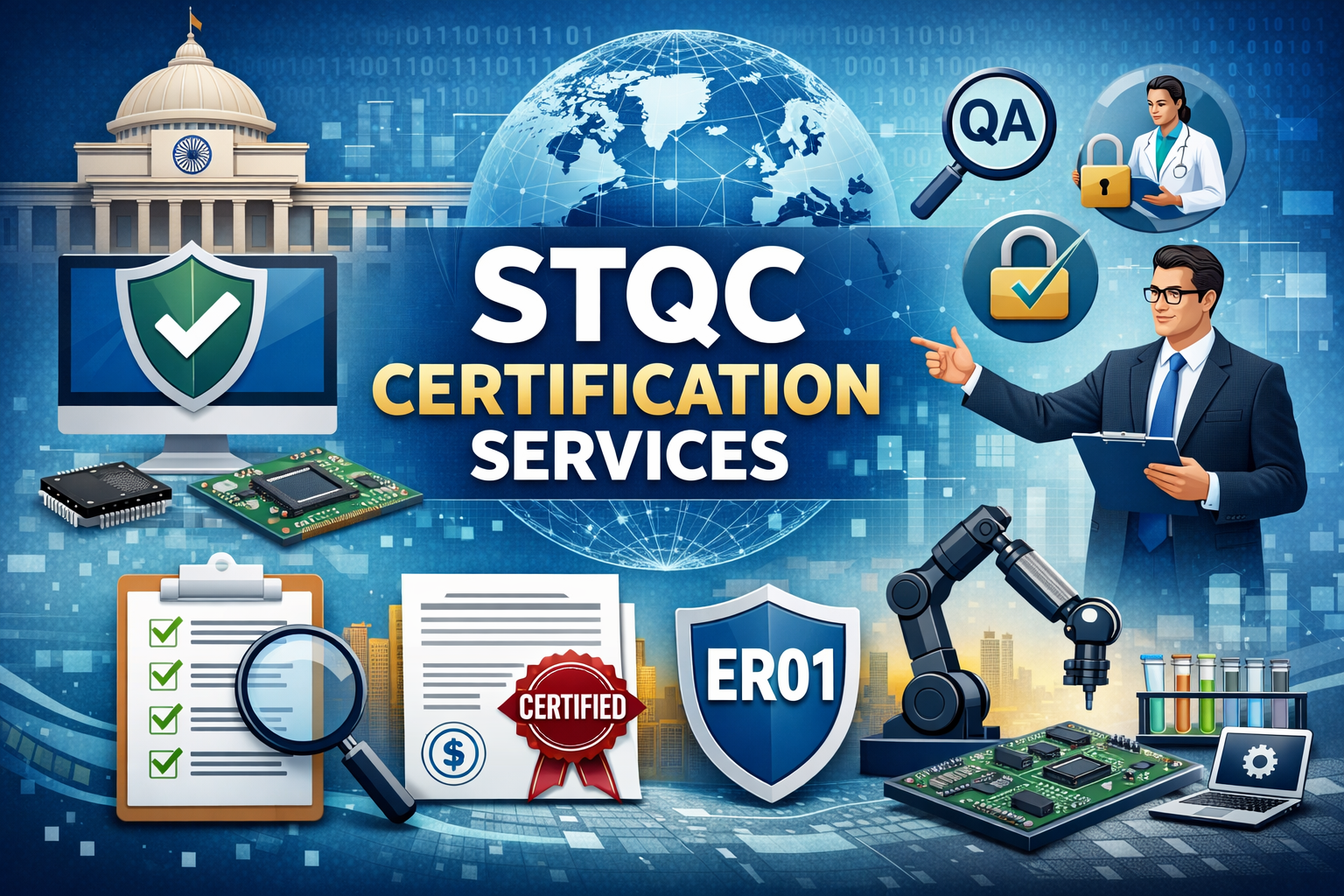
In today’s rapidly evolving digital ecosystem, government departments and private organizations must ensure that their software and IT systems meet strict quality and security standards. This is where STQC Certification Services play a crucial role. Standardization Testing and Quality Certification (STQC) ensures that products and solutions comply with national quality benchmarks and cybersecurity requirements.
Organizations working with government portals, e-governance platforms, smart devices, and digital applications often require official validation through STQC certification before deployment. These certifications enhance trust, improve system reliability, and ensure regulatory compliance.
Professional guidance from an experienced STQC Certification Consultant helps businesses complete certification efficiently while avoiding delays during evaluation.
What is STQC Certification?
STQC operates under the Ministry of Electronics and Information Technology (MeitY), Government of India. It provides testing, audit, and compliance certification services for electronics, IT products, and software applications.
The main objective of STQC Certification Services is to verify whether products meet predefined quality, safety, performance, and cybersecurity standards.
Certified organizations demonstrate adherence to:
Secure software development practices
Performance testing requirements
Data protection standards
Government IT compliance norms
Reliable system architecture
This certification is widely required for government tenders and digital infrastructure projects.
Importance of STQC Certification Services for Businesses
Modern digital solutions must undergo rigorous validation before implementation. STQC Certification Services help organizations maintain transparency and technical excellence.
Key benefits include:
1. Government Project Eligibility
Many public sector projects mandate STQC certification before approval.
2. Improved Product Credibility
Products recognized as STQC certified products gain higher market confidence.
3. Enhanced Security Compliance
Certification ensures applications meet cybersecurity standards.
4. Quality Assurance Validation
Independent testing services verify performance and operational efficiency.
5. Market Expansion Opportunities
Certified companies can participate in national digital transformation initiatives.
Understanding the STQC Certification Process
The STQC certification process involves multiple evaluation stages designed to ensure accuracy and compliance.
Step 1: Application Submission
Organizations apply for STQC Certification Services with required documentation.
Step 2: Documentation Review
Experts analyze system architecture, functionality, and compliance readiness.
Step 3: Product Testing
Authorized laboratories conduct standardization testing and performance validation.
Step 4: Security Assessment
Security audits ensure software protection against vulnerabilities.
Step 5: Certification Approval
After successful evaluation, official certification is granted.
Working with an experienced STQC ER01 Consultant significantly simplifies this process.
STQC ER01 Certification Explained
One of the most important frameworks under STQC is STQC ER01 certification, especially relevant for electronic service delivery systems and e-governance applications.
This certification focuses on:
Information security compliance
Application reliability
Data integrity validation
Service quality benchmarking
Organizations implementing government-facing platforms frequently require STQC ER01 certification before launch.
Professional STQC Certification Services providers help businesses prepare systems according to ER01 audit requirements.
Role of STQC Certification Consultant
A qualified STQC Certification Consultant provides strategic and technical support throughout certification.
Consultants assist with:
Gap analysis and readiness assessment
Documentation preparation
Testing coordination
Audit management
Certification approval support
Companies like Indiannexus offer expert consultancy services that help organizations achieve certification faster while ensuring complete regulatory compliance.
By partnering with specialists, businesses can reduce certification timelines and avoid costly rejections.
Industries That Require STQC Certification
Several industries rely heavily on STQC Certification Services:
E-Governance platforms
Software development companies
Smart city solutions
Financial technology systems
Electronic hardware manufacturers
Digital payment applications
Cloud-based service providers
These sectors depend on structured quality assurance and government-recognized testing validation.
Key Features of STQC Certified Products
Products that successfully obtain certification demonstrate:
Verified functionality
Secure data processing
Reliable performance testing results
Compliance with Indian IT standards
Long-term operational stability
Such STQC certified products gain a competitive advantage in both public and private markets.
Why Businesses Choose Professional Testing Services
Certification involves technical complexity and strict documentation requirements. Professional testing services ensure compliance with regulatory expectations.
Advantages include:
Faster certification timelines
Reduced compliance risks
Expert audit preparation
Accurate technical validation
Smooth approval procedures
Using professional STQC Certification Services ensures organizations meet national standards without operational disruption.
Future of STQC Certification in India
India’s push toward Digital India, cybersecurity enforcement, and secure IT infrastructure is increasing demand for STQC certification. Government agencies now prioritize certified platforms to maintain transparency and system reliability.
As digital transformation accelerates, businesses adopting STQC Certification Services early gain long-term advantages in compliance readiness and project approvals.
Conclusion
Obtaining certification is no longer optional for organizations involved in government or digital infrastructure projects. STQC Certification Services ensure systems meet required security, performance, and quality standards.
With expert guidance from experienced consultants and organizations such as Indiannexus, companies can successfully navigate the STQC certification process, achieve compliance certification, and deliver trusted digital solutions.
Investing in certification ultimately strengthens credibility, improves product quality, and opens new growth opportunities across India’s expanding technology ecosystem.
FAQs – STQC Certification Services
1. What are STQC Certification Services?
They are government-authorized testing and certification services that validate software, electronics, and IT systems for quality and compliance.
2. Who needs STQC certification?
Organizations developing government software, e-governance applications, or secure digital platforms require certification.
3. What is STQC ER01 certification?
It is a certification framework focused on security and quality evaluation for electronic service delivery systems.
4. How long does the STQC certification process take?
Typically, the process may take 4–8 weeks depending on product readiness and testing requirements.
5. Why hire an STQC Certification Consultant?
Consultants simplify documentation, testing coordination, and audit preparation to ensure faster approval.
6. Are STQC certified products mandatory for government projects?
Yes, many government tenders require certified systems before deployment.
7. What documents are required for STQC certification?
Technical documentation, system architecture details, security policies, and application information are commonly required.