




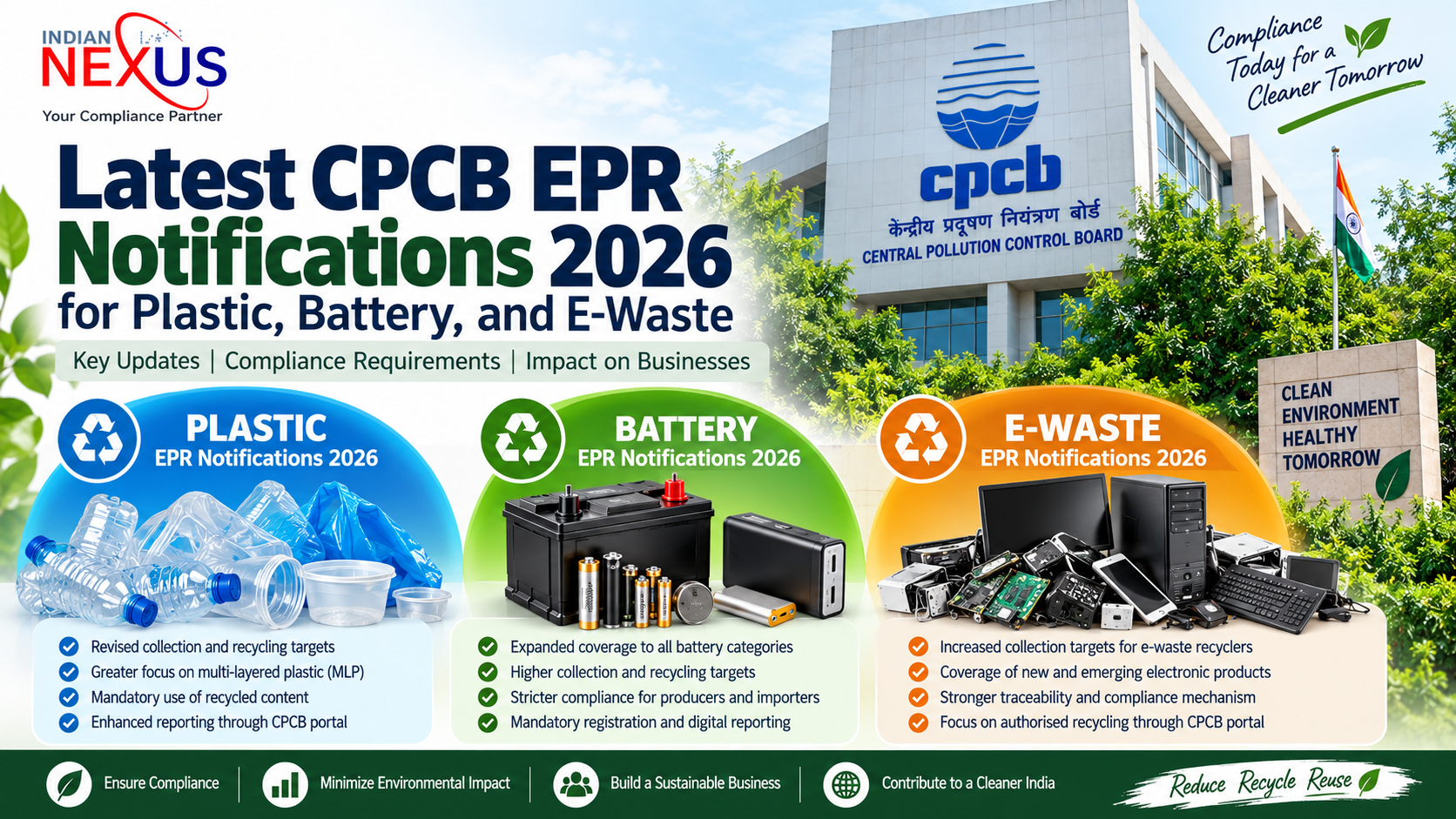
If your company's manufacturing, imports, sales, and distribution products come under the purview of the Indian waste management rules, then it's crucial to keep yourself updated with the Latest CPCB EPR Notifications 2026 for Plastic, Battery, and E-Waste. The Central Pollution Control Board is regularly augmenting their EPR compliance by upgrading the registration, tracking of the recycling certificate, reporting of sales, and surveillance of accountable entities.
In India, for any producer, importer, and brand owner (PIBOs), manufacturers, recyclers, refurbishers, or waste managing entities, the New CPCB EPR Notifications 2026 for Plastics, Batteries, and E-waste notification is important for being compliant. In addition to this, it will minimize your regulatory risks.
At Indiannexus, we assist businesses with EPR Registration India, CPCB documentation, portal applications, recycling compliance, and ongoing reporting requirements for plastic waste, battery waste, and e-waste.
CPCB EPR Updates 2026
New CPCB EPR Notifications for the year 2026 for plastic, batteries, and e-waste put a significant emphasis on traceability through digitization. Companies will be mandated to store precise data relating to products in the market, waste, collection efforts, recycling efforts, as well as EPR liabilities.
The major areas of compliance include:
CPCB EPR Registration Process
EPR Return Filing
Recycling target fulfillment
Authorized recycler coordination
EPR certificate management
Waste collection documentation
Annual compliance reporting
CPCB Environmental Compliance
Businesses should regularly monitor CPCB EPR Updates 2026 and CPCB Guidelines 2026 because requirements can vary according to the applicable waste category and business activity.
Plastic Waste EPR Compliance
Plastic manufacturers, importers, and brand owners must comply with the applicable Plastic Waste Management Rules and EPR requirements. The Latest CPCB EPR Notifications 2026 for Plastic, Battery, and E-Waste place greater emphasis on responsible plastic packaging management and achievement of applicable recycling obligations.
Under Plastic Waste EPR Compliance, businesses may need to maintain records concerning plastic packaging introduced into the market and fulfill applicable Plastic EPR Targets 2026 through eligible waste-management channels.
Our Plastic EPR services include:
Plastic EPR Registration
Plastic Packaging EPR support
EPR target assessment
Recycler coordination
EPR certificate assistance
EPR Return Filing
CPCB compliance documentation
Proper Plastic Packaging EPR management enables businesses to demonstrate environmental responsibility while maintaining regulatory compliance.
Battery Waste EPR Rules 2026
Battery manufacturers, producers, and importers will be responsible for managing their liabilities per the Battery Waste Management Rules 2022 and current CPCB updates. The new CPCB EPR Notifications 2026 for Plastics, Batteries, and E-Waste highlight efficient tracking, recycling, reporting, and documentation efforts.
Businesses may have to fulfill applicable Battery Recycling Obligations India through eligible recycling arrangements and maintain appropriate supporting records.
Our battery EPR assistance covers:
Battery EPR Registration
Battery category assessment
Recycling target guidance
Battery Recycling Certificate support
Authorized recycler coordination
CPCB portal assistance
Compliance return preparation
Professional assistance can help battery producers and importers better manage their annual EPR responsibilities.
E-Waste EPR Authorization
These new 2026 CPCB EPR Notices in plastic, battery, and e-waste are for the manufacturers and importers as specified in The E-Waste Management Rules, 2022. If your organization is handling any Electrical & Electronic equipment that falls under these regulations, you'll require e-waste EPR Authorization as well.
Important areas include:
E-Waste EPR Registration
E-Waste Collection Targets
E-Waste Recycling Authorization
Recycler verification
EPR certificate management
Annual return filing
CPCB portal compliance
Businesses should ensure that their e-waste is managed through appropriate authorized channels and that relevant compliance records are maintained.
CPCB EPR Portal Updates
The CPCB's digital compliance ecosystem plays an important role in EPR Registration India. The Latest CPCB EPR Notifications 2026 for Plastic, Battery, and E-Waste make it increasingly important for businesses to keep their portal information and compliance records accurate.
The CPCB EPR Portal Updates may relate to registration, reporting, certificates, targets, and other compliance activities. Businesses should periodically review their registration information and ensure that submitted data is consistent with their business records.
EPR Registration for Manufacturers, Importers and Brand Owners
Manufacturers and importers covered under applicable EPR regulations may require registration and ongoing compliance management. EPR Registration for Manufacturers and Brand Owner EPR Compliance should be handled according to the applicable waste category.
Similarly, businesses importing regulated products should understand relevant CPCB Notification for Importers and maintain appropriate documentation.
Indiannexus provides assistance with:
EPR Registration India
EPR Registration for Manufacturers
Importer EPR Compliance
Brand Owner EPR Compliance
Plastic Waste EPR Compliance
Battery EPR Compliance
E-Waste EPR Authorization
EPR Return Filing
Recycling documentation
Why Choose Indiannexus for EPR Compliance?
Choosing experienced EPR Compliance Consultants can simplify the registration and compliance process. Indiannexus provides end-to-end EPR Compliance Services for businesses seeking assistance with CPCB requirements.
Why Businesses Choose Us
Experienced compliance professionals
Support for multiple EPR categories
Assistance with CPCB documentation
EPR portal application support
Recycler and PRO coordination
EPR Return Filing assistance
Compliance monitoring
Business-focused regulatory guidance
Support for businesses across India
Specialized assistance from EPR Consultants in Delhi
Whether you need Plastic Waste EPR, Battery EPR, or E-Waste EPR support, our team helps organize the compliance process according to your business requirements.
EPR Registration Process
Latest CPCB EPR Notifications 2026 on Plastic, Battery & E-Waste makes it mandatory to follow the stipulated reporting and registration procedure.
Step 1: Business Assessment
Our experts identify your business activity, products, waste category, and applicable EPR requirements.
Step 2: Document Collection
Required business, product, authorization, and waste-management documents are collected and reviewed.
Step 3: Application Preparation
The appropriate EPR application is prepared according to the applicable CPCB requirements.
Step 4: CPCB EPR Portal Submission
The application and relevant information are submitted through the applicable CPCB EPR portal.
Step 5: Clarification and Verification
If CPCB requires additional information or clarification, we assist in preparing the appropriate response.
Step 6: Registration/Authorization
After the application is approved, it is approved for the applicable EPR registration or authorization.
Step 7: Ongoing Compliance
After registration, businesses may require assistance with recycling targets, certificates, annual returns, and other continuing obligations.
Benefits of EPR Compliance
Following the Latest CPCB EPR Notifications 2026 for Plastic, Battery, and E-Waste provides important benefits for businesses.
Key Benefits
Complying with the Regulators: Ensures you meet all relevant environmental requirements.
Less Risk from Compliance Issues: Better documentation and reporting means there are fewer common compliance problems to worry about.
Manage waste better: With EPR, you are prompted to collect, recycle and handle waste responsibly.
Business Credibility: Proving your environmental responsibility enhances stakeholders' trust.
Transparent Recording: With correct records of your EPR, you will no longer struggle to check how and what has been collected and recycled.
CircularEconomysupport: india circular economy goals facilitated through Recycling & resource recovery
Long-term compliance: When business owners focus long-term, they actively watch the latest guidelines by the CPCB and adapt.
Documents Required for EPR Registration
The exact documents depend on the waste category, business structure, and applicable EPR requirements. Common documents may include:
Certificate of Incorporation
PAN Card
GST Registration Certificate
IEC Certificate for applicable importers
Company registration details
Authorized signatory information
Product details
Product category information
Brand details
Manufacturing/import information
Packaging details for plastic EPR
Battery details for battery EPR
Electronic product details for e-waste EPR
Recycler or PRO agreements, where applicable
Previous EPR registration details, where applicable
Our team reviews the documents before application submission to minimize errors and unnecessary delays.
EPR Certificate and Recycling Compliance
An important component of EPR compliance is maintaining appropriate evidence of recycling and waste processing. Businesses may require valid certificates from eligible recyclers or other authorized entities to demonstrate fulfillment of applicable obligations.
Battery and e-waste companies need proper recycling documents. This is useful to meet specific obligations and requirements. For plastic companiesPlasticWaste EPR Compliance is key.
Producer Responsibility Organization (PRO) Support
A producer responsibility organization (PRO) can support obligated businesses in the taking and disposal of waste, where relevant. Businesses need to assure their disposal operations, making sure that disposal operations are duly evidenced.
Indiannexus can assist businesses in understanding PRO-related requirements and coordinating their broader EPR compliance activities.
Conclusion
Latest CPCB EPR Notifications 2026 for Plastic, Battery, and E-Waste prove that India is persistently concentrating on enhancing producer responsibility and waste management. Producers, Importers, Brand Owners, and Manufacturers should proactively track CPCB EPR updates 2026, make sure that they keep meticulous accounts and satisfy the e-waste recycling mandates and do EPR compliance.