






Growing demand for premium quality decorative plywood and interior wooden products in India means that manufacturers will continue to be required by law (BIS standards) to manufacture these products in compliance with applicable BIS Standards. Manufacturers who wish to provide assurance to consumers that their products comply with Indian National Standards (ISI Mark (Veneer Decorative Plywood IS 1328)) must comply with all established standards and achieve ISI Certification.
At Indiannexus, we offer professional consultancy services for securing ISI Mark Certification for Veneered decorative plywood IS 1328, to help manufacturers navigate the certification process easily and effectively.
Understanding IS 1328 for Veneered Decorative Plywood
Decorative veneer plywood IS 1328:1996 This specification covers the requirements for plywood for use as decorative facing for walls, furniture, or other interior surfaces. This specification covers construction, appearance and size, bond quality and performance specifications. Manufacturers of interior decorative plywood IS 1328, furniture grades of decorative plywood and commercial grade decorative plywood must manufacture their products as per this specification to ensure that they will have consistent quality ii and performance .
ISI Mark Certification for Veneered decorative plywood IS 1328 confirms that the product has been tested and verified as per BIS standards.
Importance of BIS Certification
The demand for BIS certification for decorative plywood grows as awareness amongst consumers, architects, builders and project consultants increases.
Benefits include:
Compliance with Indian regulatory requirements
Improved customer confidence
Better acceptance in government and private projects
Enhanced product credibility
Competitive advantage in the marketplace
The ISI Mark Certification for Veneered decorative plywood IS 1328 serves as proof that the product complies with the prescribed quality standards and manufacturing practices.
Applications of Veneered Decorative Plywood
The standard covers plywood used in various decorative and architectural applications, including:
Wall paneling veneered decorative plywood IS 1328
Furniture manufacturing
Decorative interior panels
Commercial office interiors
Residential decoration projects
Architectural woodwork
Modular furniture production
Many builders prefer ISI certified decorative plywood because it ensures reliability and long-term performance.
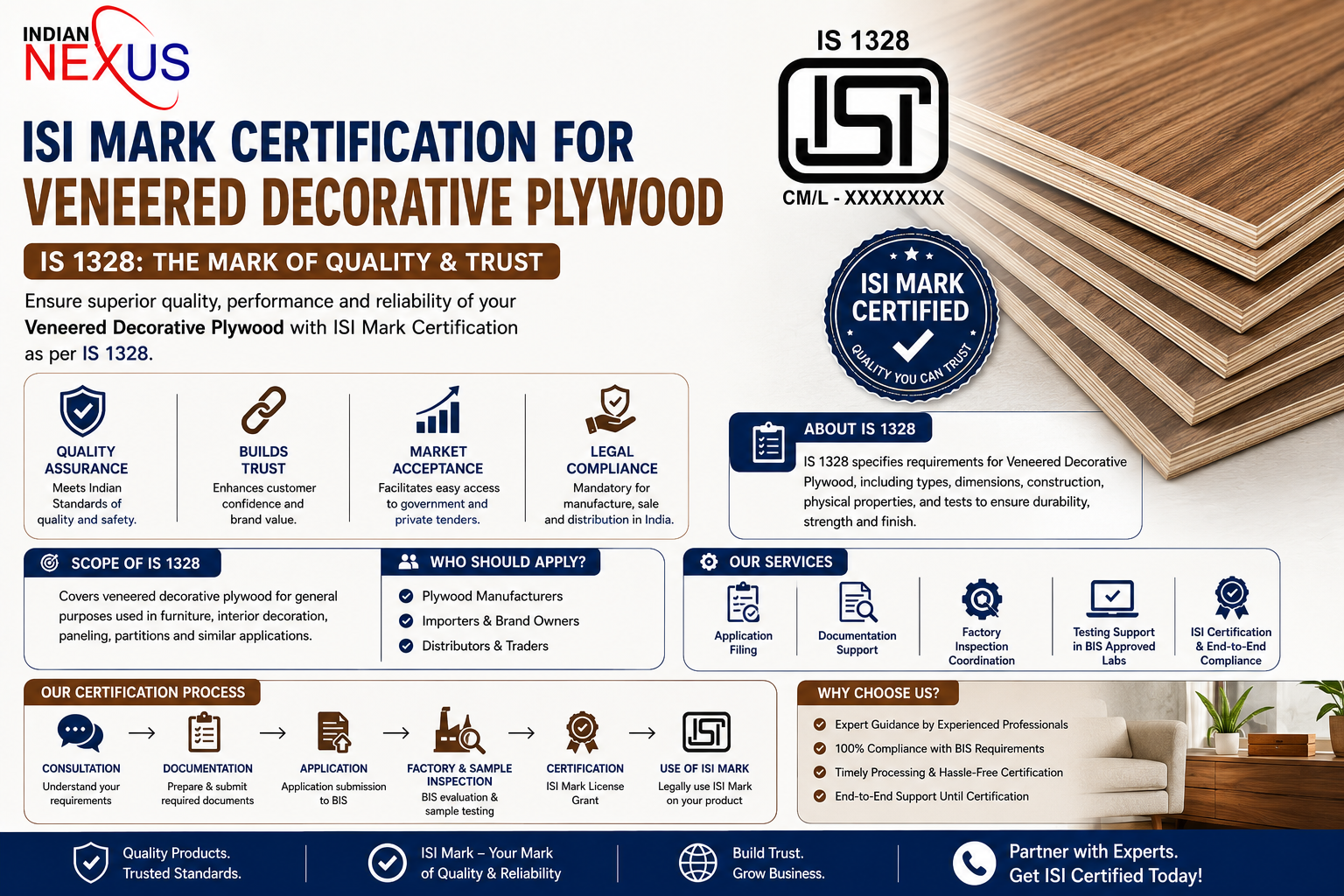
BIS Certification Process
The process for obtaining ISI Mark Certification for Veneered decorative plywood IS 1328 involves several stages.
1. Application Submission
The manufacturer submits an application along with technical documents and manufacturing details.
2. Factory Assessment
BIS officials inspect the production facility to verify manufacturing infrastructure and quality management systems.
3. Product Testing
Samples undergo decorative plywood testing as per IS 1328 in BIS-recognized laboratories.
4. Compliance Verification
The test results are evaluated to ensure IS 1328 plywood standard compliance.
5. Grant of License
Upon successful completion, BIS issues the BIS license for veneered plywood, allowing the manufacturer to use the ISI mark.
Our experts at Indiannexus assist throughout the entire certification process.
Testing Requirements Under IS 1328
Manufacturers must ensure compliance with various testing parameters, including:
Dimensional accuracy
Surface finish
Bonding strength
Moisture resistance
Veneer quality
Structural integrity
Proper IS 1328 decorative plywood testing helps verify product performance and durability.
Products meeting these requirements qualify as quality certified veneered plywood and gain recognition in the market.
Why Manufacturers Choose Indiannexus
Indiannexus provides end-to-end support for:
Documentation preparation
Application filing
Laboratory coordination
BIS audit support
Compliance management
Quality control guidance
Our team assists manufacturers to get ISI Mark Certification for their veneered decorative plywood (IS 1328) and minimizes the delays and compliance risk involved in the process. Specifically our experts can help you to get veneer faced plywood certification, decorative plywood production BIS certification or veneered plywood BIS compliance. We have experience with manufacturers and will give you the best service in time.
Market Benefits of Certification
Certified manufacturers gain significant advantages:
Increased trust among buyers
Improved opportunities in government procurement
Recognition as a BIS approved decorative plywood supplier
Stronger brand reputation
Better access to institutional projects
As demand grows for premium decorative plywood ISI mark products, certification becomes a valuable business asset.
Manufacturers producing plywood furniture veneered decorative plywood, decorative panels, and interior products can benefit greatly from ISI Mark Certification for Veneered decorative plywood IS 1328.
FAQs
1. What is ISI Mark Certification for Veneered decorative plywood IS 1328?
BIS certification that confirms decorative veneered plywood conforms to the quality requirements as specified in IS 1328.
2. Which products are covered under IS 1328?
The ornamental veneered plywood for furniture, interior wall panels and decorative furnishings.
3. Is testing mandatory for certification?
Yes. Product samples must pass BIS-approved laboratory testing.
4. What is the purpose of IS 1328?
The standard set the requirements concerning quality, durability, appearance and performances of Decorative plywood.
5. Who can apply for certification?
Any eligible veneered decorative plywood manufacturer certification applicant operating a manufacturing facility in India.
6. How long does BIS certification take?
Depending on documentation, test, and factory inspection results, the time frame will change.
7. Why should manufacturers obtain certification?
Certification has beneficial consequences for market acceptance, regulatory compliance and consumer confidence.