






India's gadgets market is expanding rapidly, creating numerous opportunities for product creators, importers, and brand owners. However, before selling electronic products in the country, businesses are required to follow the standards established by the Bureau of Indian Standards (BIS). This guide provides a comprehensive overview of BIS registration for electronics in 2026, covering the process, eligibility criteria, required documents, associated costs, benefits, and the steps to obtain approval smoothly.
BIS registration for electronics is a mandatory certificate issued under the Compulsory Registration Scheme (CRS) by the BIS.
This certificate ensures that electronic products available in the Indian market meet the country's safety and quality standards. Manufacturers must have their products tested in laboratories approved by BIS and obtain registration before they can legally sell their products in the market.
Some common electronic items that require BIS registration include mobile phones, laptops, tablets, smartwatches, LED lights, power banks, Bluetooth speakers, printers, UPS systems, CCTV cameras, smart TVs, and wireless keyboards and mice.
The list of products is continuously expanding as the government introduces new quality regulations.
Registering with BIS offers several advantages.
It helps businesses comply with legal requirements, provides access to the Indian market, strengthens consumer confidence, reduces business risks, and boosts competitiveness. It's important to note that BIS registration is generally issued to the manufacturer, not the importer.
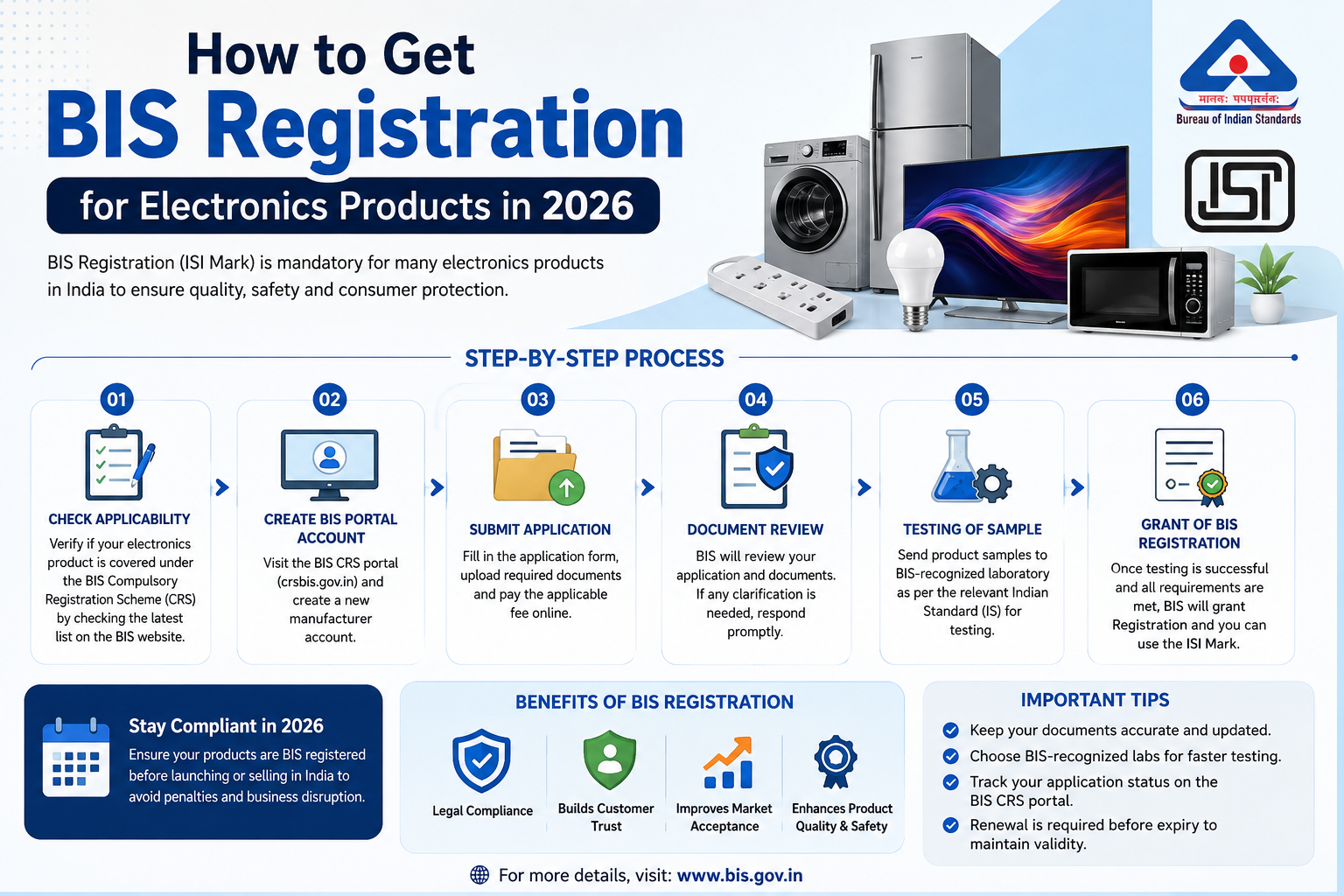
The process for BIS registration involves several steps.
First, the correct Indian Standard for the product must be identified. Next, the product is tested in a BIS-approved laboratory. All necessary documents, such as business registration details, product specifications, and test reports, must be gathered. The application is then submitted online via the BIS portal. BIS officials will review the application and may request additional information if needed. If the application is approved, a registration certificate is issued, and the BIS mark can be used on the product and its packaging.
The required documents for BIS registration may vary depending on the product type, but commonly include manufacturer-related documents like company registration, factory license, and GST information, product-related documents such as specifications and user manuals, and compliance documents like test reports and authorization letters.
The time required to obtain BIS registration can vary based on the product and the completeness of the submitted documentation.
Typically, product testing takes between 15 to 30 days, document preparation takes 5 to 10 days, the application review process takes 15 to 30 days, and registration approval may take 30 to 60 days. With proper planning and preparation, many companies can complete the process within 4 to 8 weeks.
Common challenges during the BIS registration process include incorrect product classification, incomplete documentation, errors in test reports, and improper labeling.
Working with experts can help avoid these issues.
For example, a foreign manufacturer exporting Bluetooth speakers to India would need to identify the correct BIS standard, conduct product testing, obtain a test report, appoint an Authorized Indian Representative if necessary, and apply for BIS registration before importing the goods.
Without proper registration, customs authorities may prevent the product from entering the country.
We offer comprehensive BIS compliance services to support businesses at every stage.
Our team assists with product evaluation, document preparation, lab coordination, and application submission. We ensure complete compliance while allowing you to focus on growing your business.
Frequently asked questions:
1. Is BIS registration required for all electronic products?
No, it is only required for products listed under the Compulsory Registration Scheme (CRS).
2. Can importers apply for BIS registration directly?
Typically, the manufacturer applies for BIS registration, but foreign manufacturers can appoint an Authorized Indian Representative.
3. How long does BIS registration last?
BIS registration is usually valid for a long period, though renewal may be necessary. It is important to stay updated with BIS guidelines.
4. What happens if you sell products without BIS registration?
You may face penalties, product recalls, legal consequences, and issues with customs authorities.
5. How much does BIS registration cost?
The cost varies depending on the product type, testing requirements, lab fees, and government charges.
Conclusion
As India's electronics industry continues to expand in 2026, regulatory compliance has become more important than ever. Obtaining BIS Registration for Electronics Products not only ensures legal market access but also enhances product credibility, consumer trust, and business growth.
Manufacturers, importers, and brand owners should begin the registration process early, maintain proper documentation, and ensure product testing is completed through approved laboratories.