




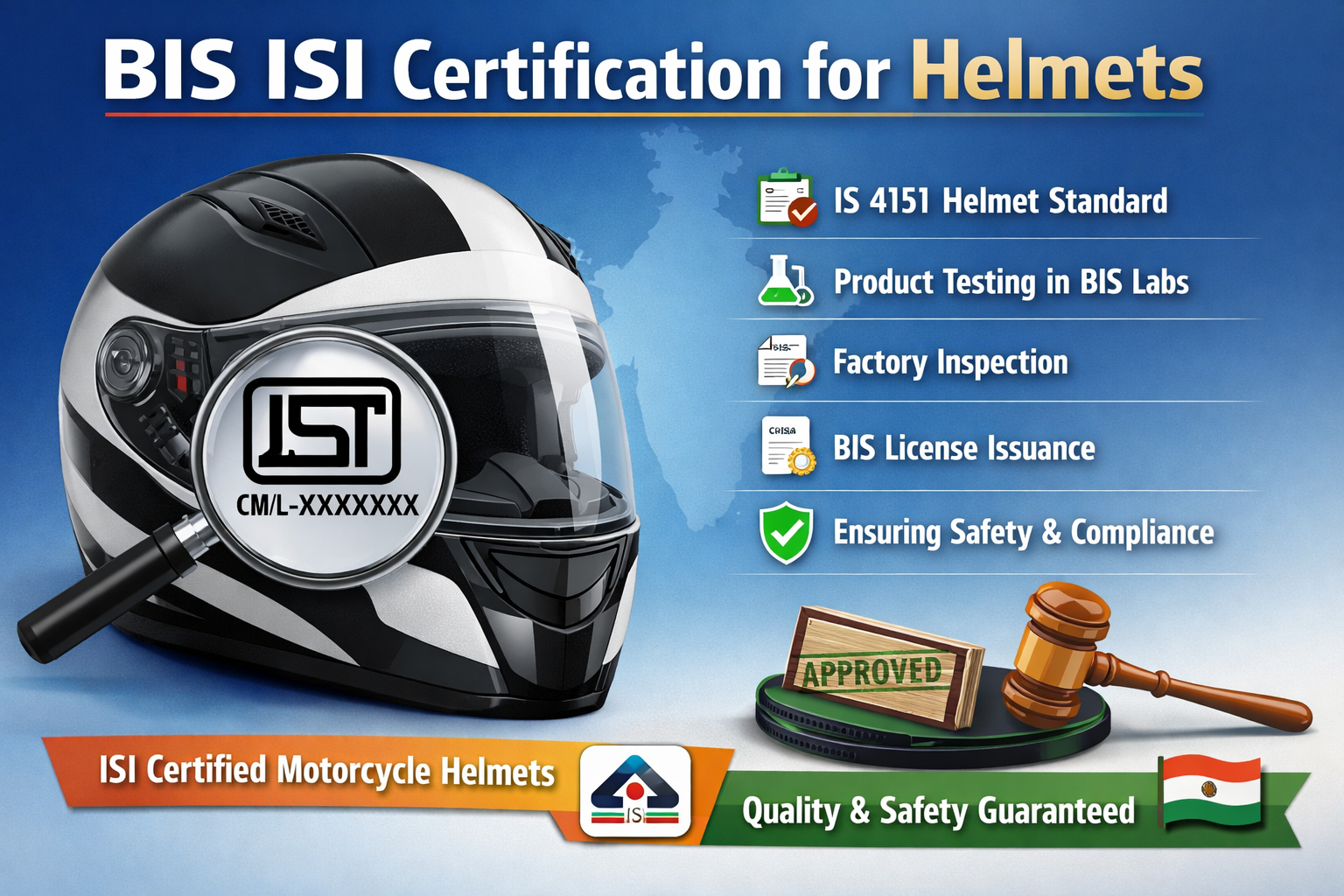
Road safety has become a top priority in India, and helmets play a vital role in protecting riders from serious injuries. To ensure quality and safety, the Government of India mandates BIS ISI certification for helmets before they are sold in the Indian market. This certification confirms that helmets meet strict safety and performance standards defined by the Bureau of Indian Standards (BIS). Manufacturers and importers must comply with these requirements to avoid penalties and product bans.
This blog explains the importance, standards, process, and benefits of BIS ISI certification for helmets, with expert guidance from Indiannexus, a trusted compliance consultant in India.
What Is BIS ISI Certification for Helmets?
BIS ISI certification for helmets is a mandatory conformity assessment that ensures helmets comply with Indian safety norms. The ISI mark indicates that a helmet has been tested and approved under the IS 4151 helmet standard, which specifies requirements related to impact absorption, penetration resistance, retention system strength, and field of vision.
Every manufacturer producing helmets for two-wheelers must obtain BIS ISI certification for helmets before launching products in India.
Why Is ISI Certification for Helmets Mandatory in India?
The Ministry of Road Transport and Highways has made ISI certification for helmets compulsory due to increasing road accidents. Non-compliant helmets often fail during impact, leading to severe injuries or fatalities.
Key reasons for mandatory certification include:
Ensuring rider safety
Eliminating substandard helmet products
Improving overall road safety standards
Legal compliance for manufacturers and sellers
Without BIS ISI certification for helmets, products can be seized, and manufacturers may face heavy fines or legal action.
Applicable Standard: IS 4151 Helmet Standard
All helmets in India must comply with the IS 4151 helmet standard, which covers:
Shock absorption performance
Resistance to penetration
Retention system effectiveness
Chin strap durability
Peripheral vision requirements
Meeting BIS standards for helmets ensures consistent quality and enhanced safety for end users.
Helmet ISI Certification Process
The helmet ISI certification process involves multiple stages and technical documentation. Below is an overview:
Application Submission
Manufacturers submit an application to BIS along with product and factory details.Product Testing
Helmet samples are tested in BIS-recognized laboratories as per IS 4151.Factory Inspection
BIS officials inspect manufacturing facilities, quality control systems, and testing infrastructure.Grant of License
Upon successful evaluation, BIS issues the ISI license.Marking & Surveillance
Certified products must display the ISI mark, and BIS conducts periodic surveillance.
Obtaining BIS ISI certification for helmets requires technical expertise, which is why many manufacturers rely on consultants like Indiannexus.
Role of Indiannexus in Helmet ISI Certification
Indiannexus is a leading BIS consultancy firm helping manufacturers achieve BIS approval for helmets efficiently. Their services include:
Documentation preparation
Coordination with BIS labs
Factory inspection assistance
Compliance gap analysis
End-to-end certification support
With Indiannexus, manufacturers can avoid delays and ensure smooth approval of BIS ISI certification for helmets.
Benefits of a BIS License for Helmet Manufacturers
Holding a BIS license for helmet manufacturers offers several advantages:
Legal authorization to sell helmets in India
Increased consumer trust due to the ISI mark
Competitive edge in domestic and government tenders
Reduced risk of product rejection or recalls
Certified products are widely accepted as ISI-certified motorcycle helmets, ensuring better market penetration.
ISI Mark for Helmets: What It Signifies
The ISI mark for helmets signifies compliance with Indian safety standards. It assures consumers that the helmet has undergone rigorous testing and meets quality benchmarks. Selling helmets without this mark is illegal under Indian law.
Common Mistakes to Avoid During Certification
Submitting incomplete documentation
Using non-compliant raw materials
Poor in-house testing facilities
Ignoring BIS surveillance requirements
Professional guidance ensures smooth approval of BIS-ISI certification for helmets, avoiding unnecessary rejections.
Frequently Asked Questions (FAQ)
Q1. Is the BIS ISI certification for helmets mandatory for all manufacturers?
Yes, all helmet manufacturers and importers must obtain ISI certification before selling in India.
Q2. Which standard applies to helmet certification in India?
Helmets must comply with the IS 4151 helmet standard.
Q3. Can imported helmets be sold without ISI certification?
No, imported helmets also require BIS ISI certification for helmets.
Q4. How long does the helmet ISI certification process take?
Typically, it takes 3–4 months, depending on documentation and factory readiness.
Conclusion
BIS ISI certification for helmets is not just a regulatory requirement—it is a commitment to safety and quality. Compliance with BIS standards for helmets ensures legal market access and builds consumer trust. With expert assistance from Indiannexus, manufacturers can navigate the certification process smoothly and launch compliant, high-quality helmets in the Indian market.