






The Indian steel industry plays a critical role in infrastructure, construction, automotive, and engineering sectors. To ensure safety, quality, and consistency, the Government of India mandates BIS certification for steel under the Bureau of Indian Standards (BIS). Compliance with BIS norms is not just a legal requirement but also a mark of trust and reliability in the competitive market.
What is BIS Certification for Steel?
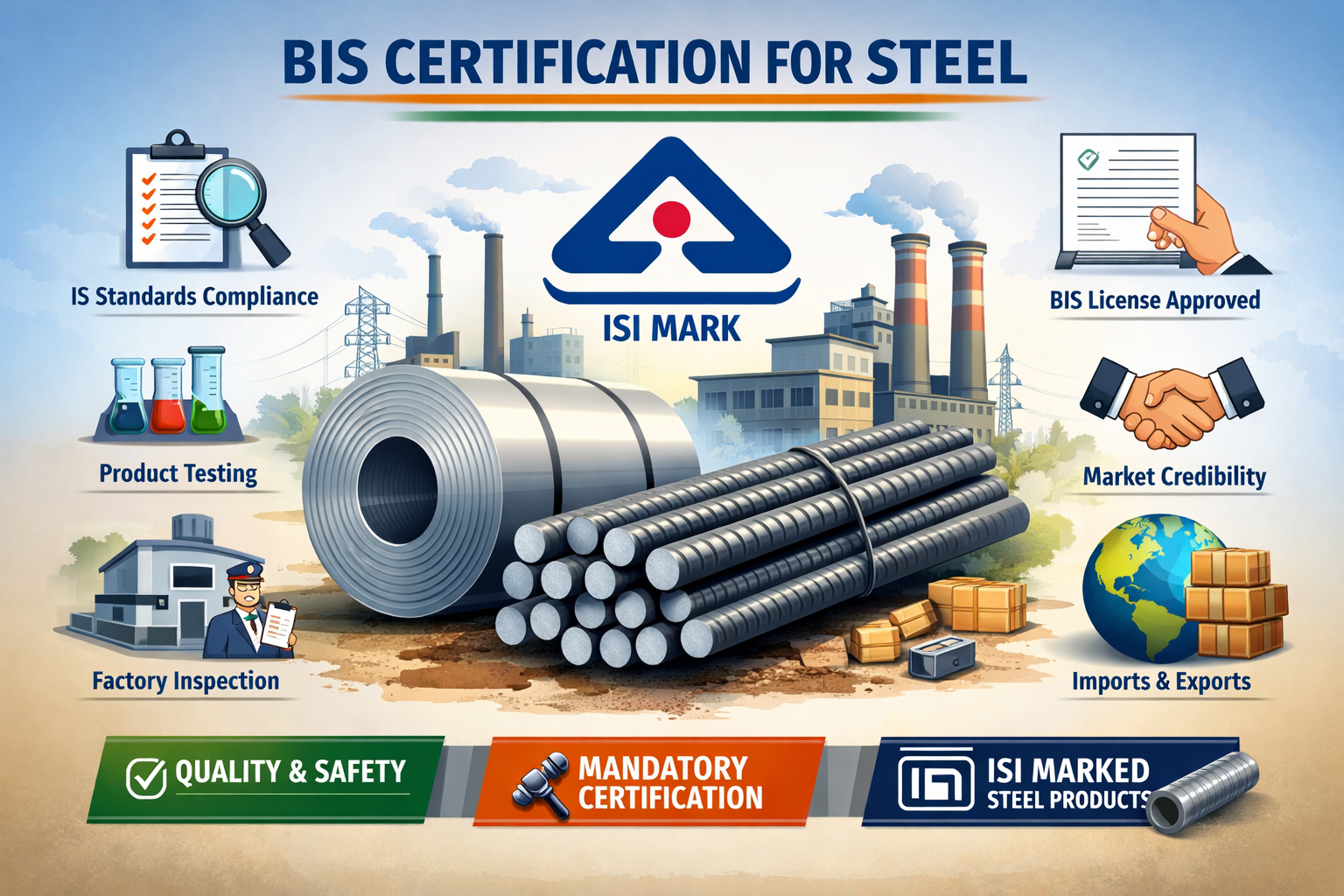
BIS certification for steel is a mandatory conformity assessment that ensures steel products meet the prescribed Indian Standards (IS). These standards define parameters such as chemical composition, mechanical strength, durability, and safety.
Steel products without BIS approval cannot be manufactured, sold, imported, or distributed in India. The certification process helps protect consumers while maintaining quality benchmarks across the steel industry.
Why BIS Certification is Mandatory for Steel Products
The government has made BIS certification compulsory for various steel products due to their widespread use in critical applications. BIS-certified steel ensures:
Structural safety in construction
Reliability in industrial applications
Uniform quality across manufacturers
Consumer confidence and market credibility
Without BIS compliance for manufacturers, steel products may face penalties, seizure, or business disruption.
BIS for Steel Products Covered Under Mandatory Certification
BIS mandates certification for a wide range of steel products, including:
TMT bars and reinforcement steel
Structural steel
Hot-rolled steel sheets and coils
Stainless steel products
Alloy steel and carbon steel
Each product must comply with specific BIS steel IS standards, such as IS 1786 for TMT bars and IS 2062 for structural steel.
Understanding BIS Steel IS Standards
BIS steel IS standards define technical and safety requirements, including:
Tensile strength
Yield strength
Elongation
Chemical composition
Manufacturing process controls
Manufacturers must strictly adhere to these standards to obtain and maintain certification. Non-compliance can result in suspension or cancellation of the BIS license.
BIS Process Steel – Step-by-Step Overview
The BIS process steel certification involves multiple stages:
Application Submission
Manufacturers apply with technical details and factory information.Product Testing
Steel samples are tested in BIS-recognized laboratories.Factory Inspection
BIS officials inspect the manufacturing unit to verify quality control systems.Grant of License
Upon successful evaluation, BIS grants the license to use the ISI mark.Surveillance & Renewal
Regular audits ensure continued compliance with standards.
The entire process must be handled carefully to avoid delays and rejections.
Role of IndianNexus in BIS Certification for Steel
IndianNexus is a trusted consultancy offering end-to-end support for BIS certification for steel. With years of experience in regulatory compliance, IndianNexus assists manufacturers with:
Identifying applicable BIS standards
Documentation and application filing
Coordination with BIS authorities
Sample testing and audit preparation
Post-certification compliance management
Their expert guidance helps reduce approval timelines and ensures hassle-free certification.
BIS Compliance for Manufacturers – Key Requirements
To achieve BIS compliance for manufacturers, steel producers must ensure:
In-house testing facilities or third-party lab tie-ups
Proper quality management systems
Traceability of raw materials
Consistent production controls
Accurate record maintenance
Maintaining compliance is as important as obtaining the license, as BIS conducts periodic surveillance.
Benefits of Steel Certification India
Obtaining steel certification in India provides several advantages:
Legal authorization to sell in India
Enhanced brand reputation
Increased customer trust
Competitive advantage in tenders
Access to government and infrastructure projects
Certified manufacturers are perceived as reliable suppliers in both domestic and international markets.
Common Challenges in BIS Certification for Steel
Manufacturers often face challenges such as:
Complex documentation
Delays in testing reports
Non-conformity during inspections
Misinterpretation of IS standards
Working with professional consultants minimizes these risks and ensures smoother certification.
Conclusion
BIS certification for steel is essential for manufacturers aiming to operate legally and successfully in India. From understanding BIS for steel products to meeting BIS steel IS standards and completing the BIS process steel, compliance requires expertise and precision.
With expert support from IndianNexus, steel manufacturers can achieve BIS compliance efficiently and focus on delivering quality products to the market.
FAQs – BIS Certification for Steel
Q1. Is BIS certification mandatory for all steel products in India?
Yes, many steel products fall under mandatory BIS certification as per government notifications.
Q2. How long does BIS certification for steel take?
Typically, it takes 2–4 months, depending on documentation, testing, and factory inspection.
Q3. What are the BIS steel IS standards?
They are Indian Standards defining quality, strength, and safety parameters for steel products.
Q4. Can foreign manufacturers apply for BIS steel certification?
Yes, through BIS FMCS (Foreign Manufacturers Certification Scheme).
Q5. What happens if steel products are sold without BIS certification?
Non-compliance can lead to penalties, product seizure, or legal action.
Q6. Is BIS compliance for manufacturers a one-time process?
No, BIS conducts regular surveillance audits to ensure ongoing compliance.
Q7. Why hire a BIS consultant for steel certification?
Consultants simplify the process, reduce delays, and ensure error-free compliance.