




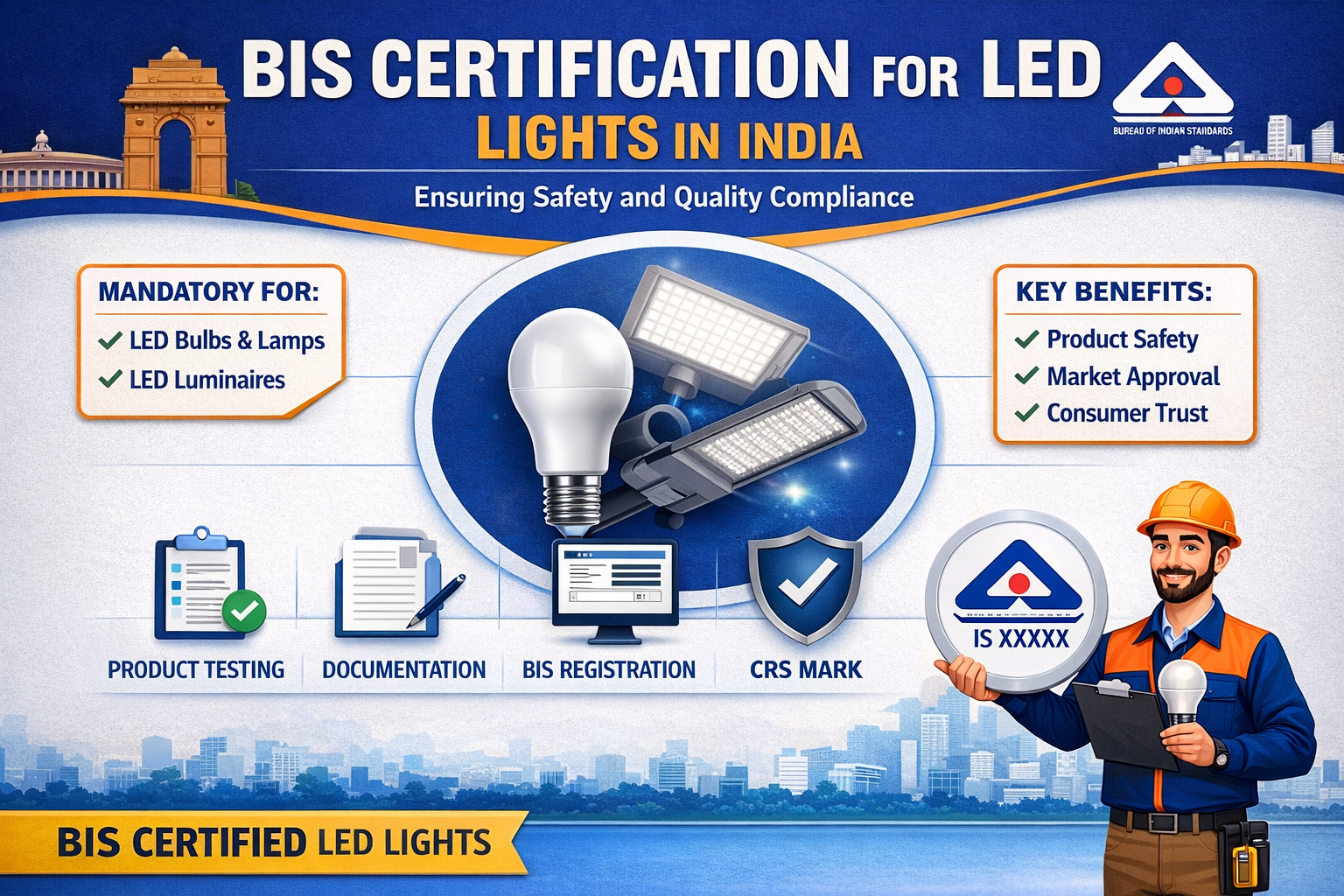
The LED lighting industry in India is growing rapidly due to energy efficiency demands, government initiatives, and infrastructure development. However, before selling LED products in the Indian market, manufacturers and importers must comply with mandatory regulatory requirements. One of the most important approvals is BIS certification for LED lights, which ensures that products meet Indian safety and quality standards. Without BIS approval, LED lights cannot be legally manufactured, imported, or sold in India.
This guide explains everything about BIS certification, applicable standards, registration procedures, and how professional consultants like Indiannexus simplify the process for businesses.
What is BIS Certification for LED Lights?
Bureau of Indian Standards (BIS) is India’s national standards body responsible for product safety and quality assurance. LED lights fall under the Compulsory Registration Scheme (CRS), which means manufacturers must register their products before market entry.
BIS certification for LED lights confirms that LED bulbs, lamps, luminaires, and related products comply with Indian Standards such as IS 16102, IS 16103, and other applicable norms. This certification protects consumers from substandard products while helping businesses build trust and credibility.
LED Products Covered Under BIS CRS Registration
The following products require BIS CRS registration for LED lights:
LED bulbs
LED luminaires
LED lamps
LED modules
LED drivers and control gear
Both domestic manufacturers and foreign manufacturers must comply. Importers cannot sell products without a valid BIS registration issued in the manufacturer’s name.
Why is BIS Approval Mandatory for LED Lights?
Obtaining BIS approval for LED lights is not optional. It is legally required due to the following reasons:
Consumer Safety – Prevents electrical hazards and fire risks
Quality Assurance – Ensures consistent product performance
Legal Market Access – Mandatory for sales on online and offline platforms
Customs Clearance – Required for importing LED products into India
Brand Trust – Certified products gain higher customer confidence
Failure to obtain BIS registration can lead to penalties, product seizure, and import restrictions.
BIS Certification Process for LED Lights
The process of BIS registration for LED bulbs and LED lights under CRS includes several structured steps:
Step 1: Product Testing
The LED product is tested in a BIS-recognized laboratory as per applicable Indian Standards.
Step 2: Documentation Preparation
Documents such as test reports, factory details, manufacturing flowcharts, and authorization letters are prepared.
Step 3: Online Application
The manufacturer submits the BIS CRS application through the BIS portal.
Step 4: Application Review
BIS officials review submitted documents and test results.
Step 5: Grant of Registration
Once approved, the manufacturer receives a BIS registration number and can mark products with the CRS logo.
Professional support from consultants like Indiannexus helps avoid delays and rejection during this process.
Documents Required for BIS License
To obtain a BIS license for LED manufacturers, the following documents are generally required:
Product test report from a BIS-recognized lab
Factory registration and address proof
Manufacturing process flowchart
List of manufacturing equipment
Authorization letter (for Indian representatives)
Trademark certificate (if applicable)
Foreign manufacturers must also appoint an Authorized Indian Representative (AIR).
BIS License for LED Lights: Who Needs It?
The BIS license for LED lights is mandatory for:
Indian manufacturers
Overseas manufacturers exporting to India
Importers dealing with LED bulbs and luminaires
Retailers and distributors must ensure that the products they sell already have valid BIS registration.
Role of Indiannexus in BIS Certification
Navigating regulatory requirements can be complex, especially for new businesses. Indiannexus is a trusted compliance partner that assists manufacturers and importers with end-to-end BIS certification services.
Indiannexus provides:
Product applicability analysis
Coordination with BIS-approved labs
Documentation and application filing
Follow up with BIS authorities
Post-certification compliance support
Their expertise significantly reduces approval timelines and compliance risks related to BIS certification for LED lights.
Common Challenges in BIS Certification
Businesses often face issues such as:
Test report non-conformities
Incomplete documentation
Incorrect standard selection
Delays in BIS response
With expert guidance, these challenges can be easily avoided.
FAQs on BIS Certification for LED Lights
Q1. Is BIS certification mandatory for LED bulbs in India?
Yes, BIS certification is mandatory for LED bulbs under the CRS scheme.
Q2. How long does BIS CRS registration for LED lights take?
The process usually takes 3–6 weeks, depending on testing and documentation.
Q3. Can importers apply directly for BIS registration?
No, BIS registration is issued in the manufacturer’s name, not the importer’s.
Q4. Is BIS certification required for all wattages of LED lights?
Yes, applicable LED products across wattages must comply with BIS standards.
Q5. How long is BIS registration valid?
BIS CRS registration is typically valid for two years and can be renewed.