








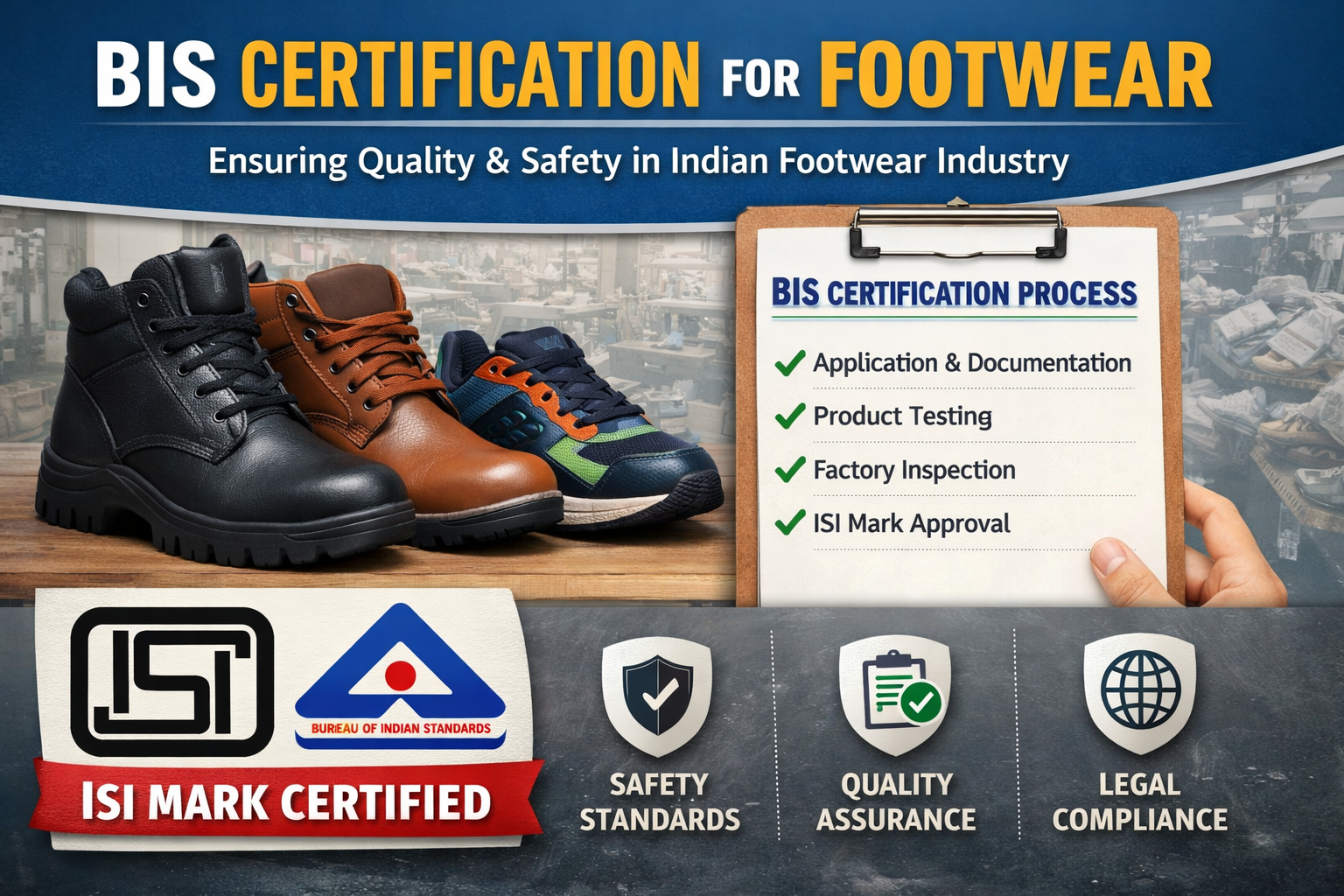
India’s footwear industry is rapidly expanding, serving both domestic and global markets. To ensure product safety, durability, and quality, the Government of India has made BIS certification for footwear mandatory for specific categories. This certification not only safeguards consumers but also helps manufacturers build credibility and legally sell their products in the Indian market.
Understanding BIS Certification for Footwear
The BIS certification for footwear is issued by the Bureau of Indian Standards (BIS) under the Quality Control Orders (QCOs). It ensures that footwear products meet defined safety, material, and performance benchmarks. Once certified, manufacturers are permitted to use the ISI mark for footwear, which signifies compliance with Indian standards.
This regulation applies to both domestic manufacturers and importers selling footwear in India. Non-compliance can result in penalties, seizure of goods, and prohibition from sale.
Why BIS Footwear Certification Is Mandatory
Footwear has a direct impact on consumer health, comfort, and safety. The use of substandard materials or poor manufacturing practices can lead to injuries and long-term health issues. BIS footwear certification ensures:
Use of safe raw materials
Proper sole adhesion and strength
Resistance to wear and tear
Comfort and durability under Indian conditions
The ISI certification for footwear also promotes fair trade by preventing low-quality imports from entering the market.
Footwear Categories Covered Under BIS Standards
As per notified QCOs, several footwear types must comply with BIS standards for footwear, including:
Leather safety shoes
PVC and rubber footwear
Industrial and protective footwear
Casual and school shoes
Sandals and slippers (specific categories)
Each category has a specific Indian Standard (IS) code that manufacturers must follow for footwear BIS certification in India.
Key BIS Standards for Footwear
Some commonly applicable standards include:
IS 15298 (Safety, protective, and occupational footwear)
IS 5676 (Rubber footwear)
IS 17043 (PVC footwear)
Meeting these BIS standards for footwear requires strict quality control, material testing, and manufacturing consistency.
Process of BIS Certification for Footwear
The BIS certification for the footwear process involves multiple technical and regulatory steps:
Application Filing
The manufacturer submits an online application for BIS registration for footwear with product and factory details.Product Testing
Samples are tested in a BIS-recognized laboratory to ensure compliance with relevant Indian Standards.Factory Inspection
BIS officials conduct an on-site inspection to verify manufacturing processes, machinery, testing facilities, and quality systems.Grant of License
After a successful evaluation, BIS issues the BIS license for footwear, allowing the use of the ISI mark.Ongoing Surveillance
Periodic inspections and sample testing ensure continuous compliance.
Documents Required for BIS License for Footwear
To obtain BIS certification for shoes, manufacturers typically need:
Factory registration documents
Quality control and test equipment list
Raw material details
Product test reports
Manufacturing flowchart
Authorization letter (for consultants)
Accurate documentation plays a vital role in faster approval.
Role of BIS Consultant for Footwear
Due to the technical nature of compliance, many businesses rely on a professional BIS consultant for footwear. A consultant assists with:
Identifying applicable standards
Coordinating lab testing
Preparing documentation
Managing BIS inspections
Reducing approval timelines
This minimizes errors and ensures smooth licensing.
How Indiannexus Helps in BIS Approval
Indiannexus is a trusted compliance partner offering end-to-end assistance for BIS approval for footwear manufacturers. With extensive experience in regulatory certifications, Indiannexus helps businesses navigate complex BIS requirements efficiently.
From initial eligibility assessment to final license grant, Indiannexus ensures a hassle-free approach to BIS certification for footwear, helping manufacturers and importers stay compliant and market-ready.
Benefits of BIS Certification for Footwear Manufacturers
Obtaining BIS certification for footwear provides several advantages:
Legal authorization to sell in India
Enhanced brand trust and credibility
Access to government tenders
Improved product quality and consistency
Competitive edge in domestic and export markets
The ISI mark for footwear acts as a powerful quality assurance symbol for consumers.
Penalties for Non-Compliance
Selling footwear without a valid BIS footwear certification can lead to:
Heavy monetary penalties
Cancellation of import consignments
Legal prosecution
Product recalls
Hence, securing the BIS license for footwear is not just beneficial but mandatory.
FAQ
Q1. Is BIS certification mandatory for all footwear in India?
Yes, specific categories notified under QCOs require mandatory BIS certification for footwear.
Q2. How long does BIS footwear certification take?
Typically, it takes 3–6 months, depending on testing, documentation, and inspection readiness.
Q3. Can importers apply for BIS certification for shoes?
Yes, importers can apply, but certification is granted to the foreign manufacturer.
Q4. What is the validity of a BIS license for footwear?
The license is generally valid for 1–2 years and can be renewed.
Yes, once certified, the ISI certification for footwear mark must be affixed to products.