







The chemical industry plays a vital role in India’s manufacturing ecosystem, supplying raw materials to pharmaceuticals, textiles, agriculture, construction, and many other sectors. To ensure quality, safety, and regulatory compliance, the Government of India mandates the BIS certification for chemicals under specific standards. This certification helps manufacturers demonstrate conformity with Indian Standards and build trust among buyers, regulators, and global partners.
Organizations like Indiannexus assist chemical manufacturers in navigating complex compliance requirements and obtaining BIS approvals efficiently.
Understanding BIS Certification for Chemicals
BIS certification for chemicals is issued by the Bureau of Indian Standards (BIS), India’s national standards body. It ensures that chemical products meet prescribed quality, safety, and performance standards before entering the Indian market.
This certification is especially important for products used in industrial processes, consumer applications, or those that may pose environmental or health risks if not properly regulated.
Why BIS Certification Is Important for Chemical Manufacturers
Obtaining BIS certification for chemicals offers several benefits:
Ensures product safety and quality
Mandatory compliance with Indian regulations
Enhances brand credibility and customer confidence
Facilitates domestic sales and government tenders
Reduces risk of legal penalties and product recalls
For manufacturers handling regulated substances, BIS chemical compliance is not optional but a legal necessity.
Types of Chemicals Covered Under BIS
BIS standards apply to a wide range of products, including:
Industrial chemicals
Specialty chemicals
Agrochemicals
Laboratory and testing chemicals
Consumer-use chemicals
Many of these fall under BIS certification for industrial chemicals, which is crucial for factories and bulk manufacturers.
Key BIS Standards for Chemicals
Each chemical product is governed by a specific Indian Standard (IS). These standards define:
Chemical composition
Purity levels
Physical and chemical properties
Packaging and labeling requirements
Safety and handling guidelines
Compliance with BIS standards for chemicals ensures uniform quality across the market.
ISI Mark for Chemicals
Once certified, manufacturers are authorized to use the ISI mark on their products for chemicals. This mark signifies that the chemical has been tested and approved as per BIS norms.
The ISI mark helps buyers easily identify compliant and reliable products, especially in B2B and government procurement.
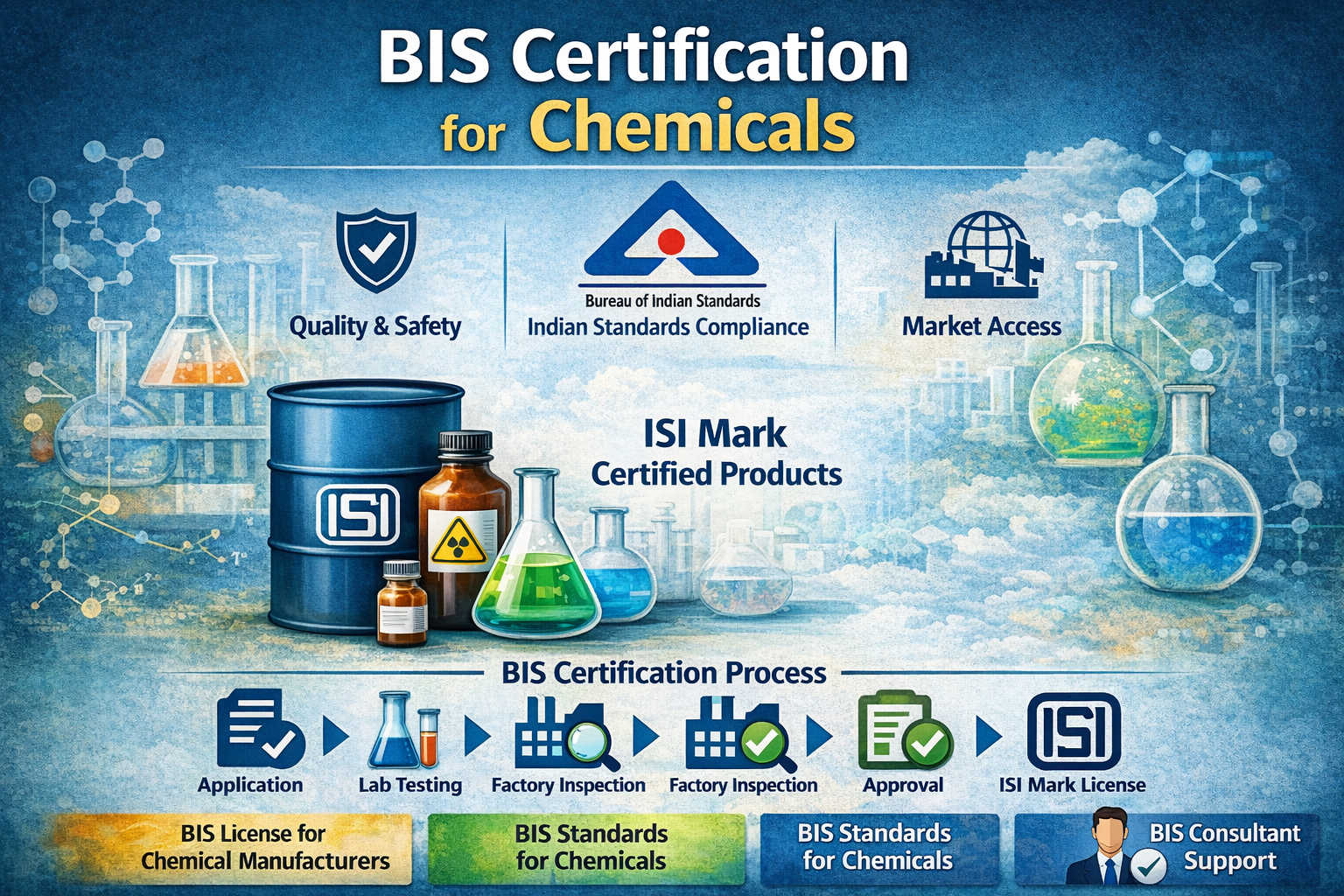
BIS Certification Process for Chemicals
The BIS certification process for chemicals typically involves the following steps:
Identification of Applicable Standard
Determine the relevant Indian Standard for the chemical product.Application Submission
Submit the BIS application along with technical documents and product details.Factory Inspection
BIS officials inspect the manufacturing facility to verify production processes, quality control, and testing infrastructure.Sample Testing
Product samples are tested in BIS-recognized laboratories.Grant of License
Upon successful evaluation, BIS approves and allows use of the ISI mark.
This process requires technical accuracy and regulatory expertise, making professional support highly valuable.
BIS License for Chemical Manufacturers
A BIS license for chemical manufacturers is issued to the manufacturing unit, not just the product. This means:
Manufacturing processes must remain consistent
Quality control systems must be maintained
Periodic surveillance audits are conducted
Any deviation may result in suspension or cancellation of the license.
BIS Registration vs BIS Certification for Chemicals
While often used interchangeably, there is a difference:
BIS certification for chemicals generally applies to products under the ISI Mark Scheme
BIS registration for chemicals may apply under specific schemes depending on the product category
Understanding the correct route is essential to avoid delays or rejection.
Role of BIS Consultant for Chemical Certification
Due to complex documentation, testing protocols, and audits, many manufacturers rely on a BIS consultant for chemical certification. Consultants help with:
Standard identification
Documentation preparation
Liaison with BIS authorities
Factory inspection readiness
Faster approval timelines
Companies like Indiannexus provide end-to-end BIS consulting services tailored for chemical manufacturers across India.
Challenges in BIS Approval for Chemicals
Some common challenges include:
Non-compliance with testing parameters
Incomplete technical documentation
Inadequate in-house testing facilities
Delays in laboratory results
Professional guidance significantly reduces these risks and ensures smooth BIS approval for chemicals.
Conclusion
In today’s regulated manufacturing environment, BIS certification for chemicals is essential for legal compliance, market credibility, and long-term business growth. From meeting BIS standards for chemicals to obtaining the ISI mark, every step requires careful planning and execution.
With expert support from consultants like Indiannexus, chemical manufacturers can achieve certification efficiently while focusing on innovation and production excellence.
FAQ – BIS Certification for Chemicals
Q1. Is BIS certification mandatory for all chemicals?
Not all chemicals require BIS certification, but many regulated and industrial chemicals do.
Q2. How long does the BIS certification process take?
It usually takes 3–6 months, depending on documentation and testing timelines.
Q3. Can small manufacturers apply for BIS certification?
Yes, both MSMEs and large manufacturers can apply if they meet BIS requirements.
Q4. Is factory inspection compulsory?
Yes, factory inspection is a mandatory part of the BIS certification process for chemicals.