






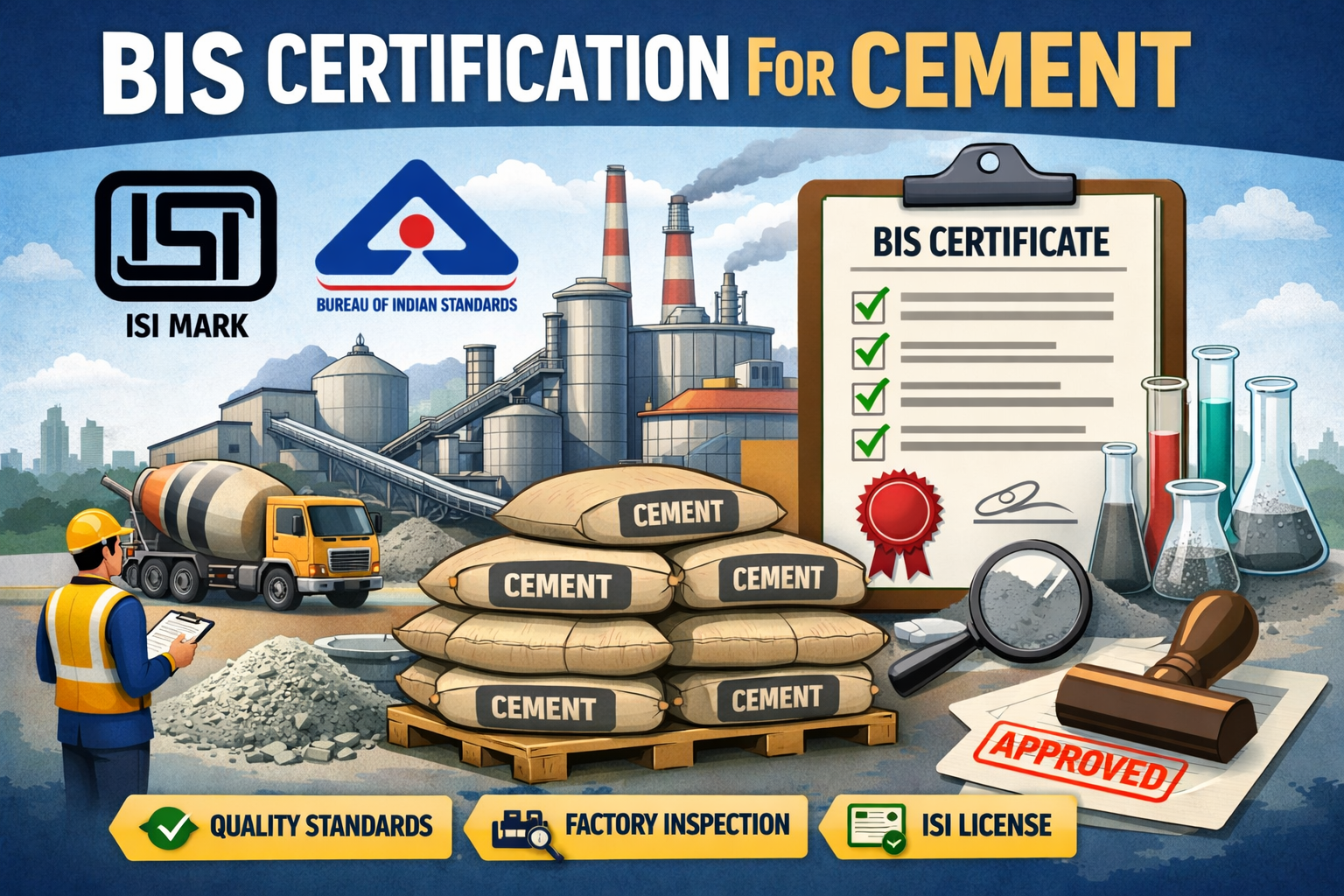
Cement is one of the most essential materials used in infrastructure development, residential construction, highways, bridges, and commercial projects. Since cement directly impacts structural strength and public safety, quality compliance is mandatory in India. This is where the BIS Certification for Cement becomes crucial for manufacturers and suppliers.
The Bureau of Indian Standards (BIS) regulates cement quality under specific Indian Standards to ensure safety, durability, and reliability. Without compliance, manufacturers cannot legally sell or distribute cement products in the Indian market.
In this blog, we will cover everything about BIS Certification for Cement, including legal requirements, documentation, licensing process, and benefits for cement manufacturers.
What is BIS Certification For Cement?
BIS Certification for Cement is a mandatory quality certification issued by the Bureau of Indian Standards under the BIS Act. It ensures that cement products comply with prescribed Indian Standards, such as:
IS 269 – Ordinary Portland Cement (33 Grade)
IS 8112 – Ordinary Portland Cement (43 Grade)
IS 12269 – Ordinary Portland Cement (53 Grade)
IS 1489 – Portland Pozzolana Cement
IS 455 – Portland Slag Cement
Once approved, manufacturers are authorized to use the ISI mark for cement products, which signifies compliance with national safety and quality norms.
Why is BIS Certification Mandatory for Cement?
The Government of India mandates BIS certification for cement manufacturers because:
Cement affects structural safety.
It ensures uniform quality standards.
It prevents substandard products in the market.
It builds consumer trust.
It supports fair competition.
Without obtaining a BIS license for cement manufacturers, production and sale are prohibited.
Types of Cement Covered Under BIS Certification
The BIS certification for cement products applies to:
Ordinary Portland Cement
Portland Pozzolana Cement
Portland Slag Cement
Rapid Hardening Cement
Low Heat Cement
Sulphate Resistant Cement
Each type must comply with its respective IS standard before receiving approval under BIS Certification For Cement.
Process for BIS Certification For Cement Products
Understanding the process for BIS certification for cement products is essential for smooth approval.
Step 1: Application Submission
The manufacturer submits an online application along with required documents and factory details.
Step 2: Documentation Review
BIS reviews manufacturing process details, quality control measures, and raw material sources.
Step 3: Factory Inspection
BIS officials inspect the manufacturing unit to verify infrastructure, testing facilities, and quality control systems.
Step 4: Sample Testing
Samples are collected and tested in BIS-approved laboratories.
Step 5: Grant of License
Upon successful compliance, the manufacturer receives the BIS license for cement products, allowing use of the ISI mark.
The complete BIS Certification For Cement process may take 30–60 days depending on compliance readiness.
Documents Required for BIS Certification
Manufacturers must provide:
Business registration certificate
Manufacturing license
Factory layout
Test reports
List of machinery
Quality control details
Authorized signatory details
Proper documentation ensures faster approval of BIS Certification For Cement.
Benefits of BIS Certification For Cement
Legal authorization to sell cement in India
Enhanced brand credibility
Permission to use the ISI mark
Increased government tender eligibility
Better market reputation
Reduced risk of penalties
Obtaining BIS Certification For Cement strengthens trust among builders, contractors, and infrastructure developers.
Role of BIS Consultants in India
The application process can be technical and documentation-heavy. Professional BIS Consultants in India help manufacturers with:
Standard identification
Documentation preparation
Factory audit guidance
Sample testing coordination
Application tracking
If you are located in North India, a BIS Consultant in Delhi can provide localized assistance for faster approvals.
Why Choose Indiannexus for BIS Certification For Cement?
When it comes to reliable compliance assistance, Indiannexus provides expert support for cement manufacturers. From documentation to inspection handling, their team ensures smooth approval under BIS Certification For Cement.
Their experience with regulatory procedures minimizes rejection risks and ensures timely issuance of the BIS license for cement products.
Common Challenges Faced by Cement Manufacturers
Incomplete documentation
Laboratory non-compliance
Improper quality control systems
Delays in sample testing
Incorrect IS standard selection
With expert guidance, manufacturers can avoid these issues during the BIS Certification For Cement process.
FAQs on BIS Certification For Cement
1. Is BIS Certification For Cement mandatory in India?
Yes, it is mandatory for manufacturing and selling cement products in India.
2. How long does BIS certification take?
Typically 30–60 days depending on documentation and inspection readiness.
3. What is the validity of the BIS license?
The license is generally valid for one to two years and must be renewed.
4. Can small cement manufacturers apply?
Yes, all manufacturers must obtain BIS Certification For Cement, regardless of size.
5. What happens if a manufacturer sells cement without certification?
Heavy penalties, product seizure, and legal action may be imposed.
6. Is factory inspection compulsory?
Yes, BIS inspection is mandatory before granting the license.
7. Who can help with the application process?
Professional BIS Consultants in India or a BIS Consultant in Delhi can assist in documentation and approvals.