





India has a rapidly growing consumer market, making product safety and quality compliance more important than ever. To ensure that goods sold in the Indian market meet prescribed safety and performance standards, the Government of India enforces certification through the Bureau of Indian Standards (BIS). BIS Certification is a mandatory regulatory requirement for a wide range of products and serves as a benchmark for quality assurance.
For manufacturers and importers, compliance with BIS norms is not only a legal obligation but also a strategic step toward building consumer trust and market credibility. Failure to obtain the required certification can result in heavy penalties, product recalls, or even bans on sales.
Understanding BIS Certification in India
BIS Certification is a conformity assessment system introduced under the BIS Act, 2016. It verifies that products comply with Indian Standards (IS) relating to safety, quality, and reliability. Products approved under BIS schemes are permitted to carry standard marks such as the ISI mark or CRS registration number.
This certification framework protects consumers from substandard goods while helping businesses demonstrate compliance with national quality benchmarks.
Major BIS Certification Schemes
India follows multiple certification schemes depending on the product category:
1. ISI Mark Certification
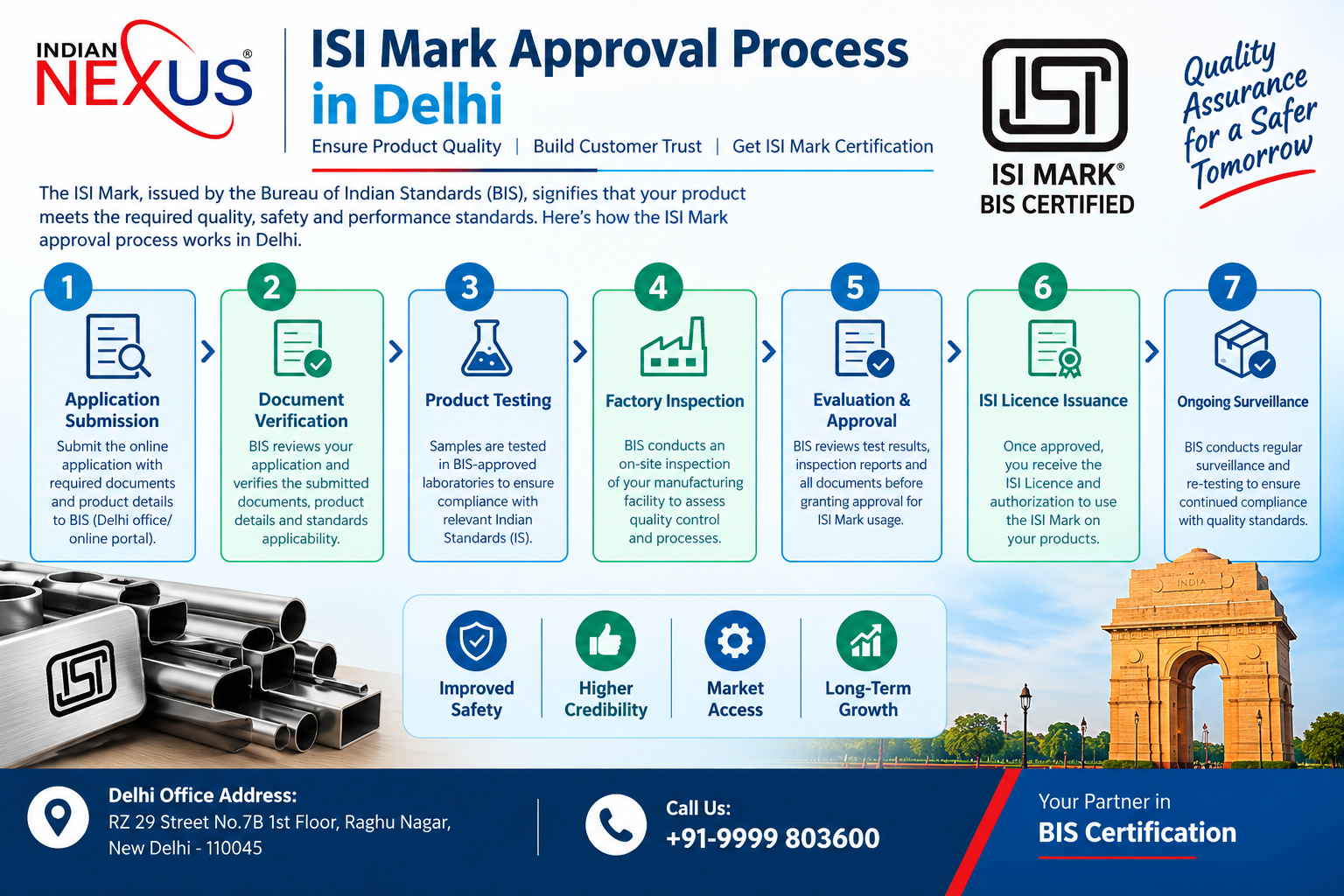
The ISI mark certification is mandatory for products like electrical appliances, cement, steel products, pressure cookers, and industrial components. Manufacturers must obtain a BIS license before affixing the ISI mark.
2. Compulsory Registration Scheme (CRS)
Under BIS Certification and Registration guidelines, CRS applies mainly to electronics and IT products such as LED lights, mobile phones, power adapters, laptops, and televisions.
3. Foreign Manufacturers Certification Scheme (FMCS)
Foreign manufacturers exporting regulated products to India must comply with FMCS, which involves factory audits and product testing in BIS-approved laboratories.
Each scheme has specific technical, documentation, and compliance requirements.
BIS Registration Process Explained
The BIS registration process involves several structured steps:
Identification of applicable Indian Standard
Product testing from BIS-recognized laboratories
Online application submission on the BIS portal
Factory inspection or verification (if applicable)
Grant of BIS license or registration number
Timelines vary depending on product complexity, testing requirements, and documentation accuracy.
Documents Required for BIS Certification
To ensure smooth approval, applicants must submit:
Product technical specifications
Test reports from BIS-recognized labs
Manufacturing process flowchart
Quality control and assurance documents
Authorization letters (for importers and representatives)
Company registration and factory details
Engaging professional BIS certification services significantly reduces the chances of rejection or delay.
Importance of BIS License and ISI Mark
A BIS license authorizes manufacturers to use the ISI mark or CRS number on approved products. The ISI mark certification signifies that the product meets all applicable Indian safety and quality standards. Benefits include:
Legal permission to sell in India
Increased customer confidence
Acceptance in government and institutional tenders
Protection against regulatory action
Role of Indiannexus in BIS Certification
Indiannexus is a well-established compliance consultancy offering end-to-end BIS Certification Consultant Services Near Me for manufacturers and importers across India. Their expertise covers:
Product applicability assessment
End-to-end BIS registration support
Coordination with testing laboratories
Documentation and application management
Liaison with BIS authorities
By partnering with Indiannexus, businesses can avoid procedural errors and achieve faster certification approvals.
Why Hire a BIS Consultant in India?
The BIS framework involves technical standards, legal procedures, and strict timelines. A professional BIS consultant in India ensures:
Correct scheme identification
Accurate documentation
Faster approvals
Ongoing compliance support
Expert consultants help businesses focus on core operations while managing regulatory responsibilities efficiently.
Advantages of BIS Certification for Businesses
Obtaining BIS Certification offers long-term commercial and regulatory benefits:
Ensures product quality and safety
Enhances brand image and market trust
Reduces legal and compliance risks
Supports business expansion in regulated sectors
Improves competitiveness in domestic and global markets
Conclusion
Compliance with BIS norms is essential for any manufacturer and importer operating in India. BIS Certification ensures that products meet mandatory safety and quality standards while strengthening consumer confidence. With expert guidance from Indiannexus, businesses can navigate the complex certification landscape smoothly and achieve timely regulatory approvals without unnecessary delays.
FAQs
Q1. Is BIS Certification mandatory for all products?
No, it is mandatory only for products notified under BIS schemes.
Q2. How long does the BIS registration process take?
Generally, 4–8 weeks, depending on product category and documentation.
Q3. What is the validity of a BIS license?
A BIS license is usually valid for 1–2 years and can be renewed.
Q4. Can importers apply for BIS registration?
Yes, importers can apply through an authorized Indian representative.