




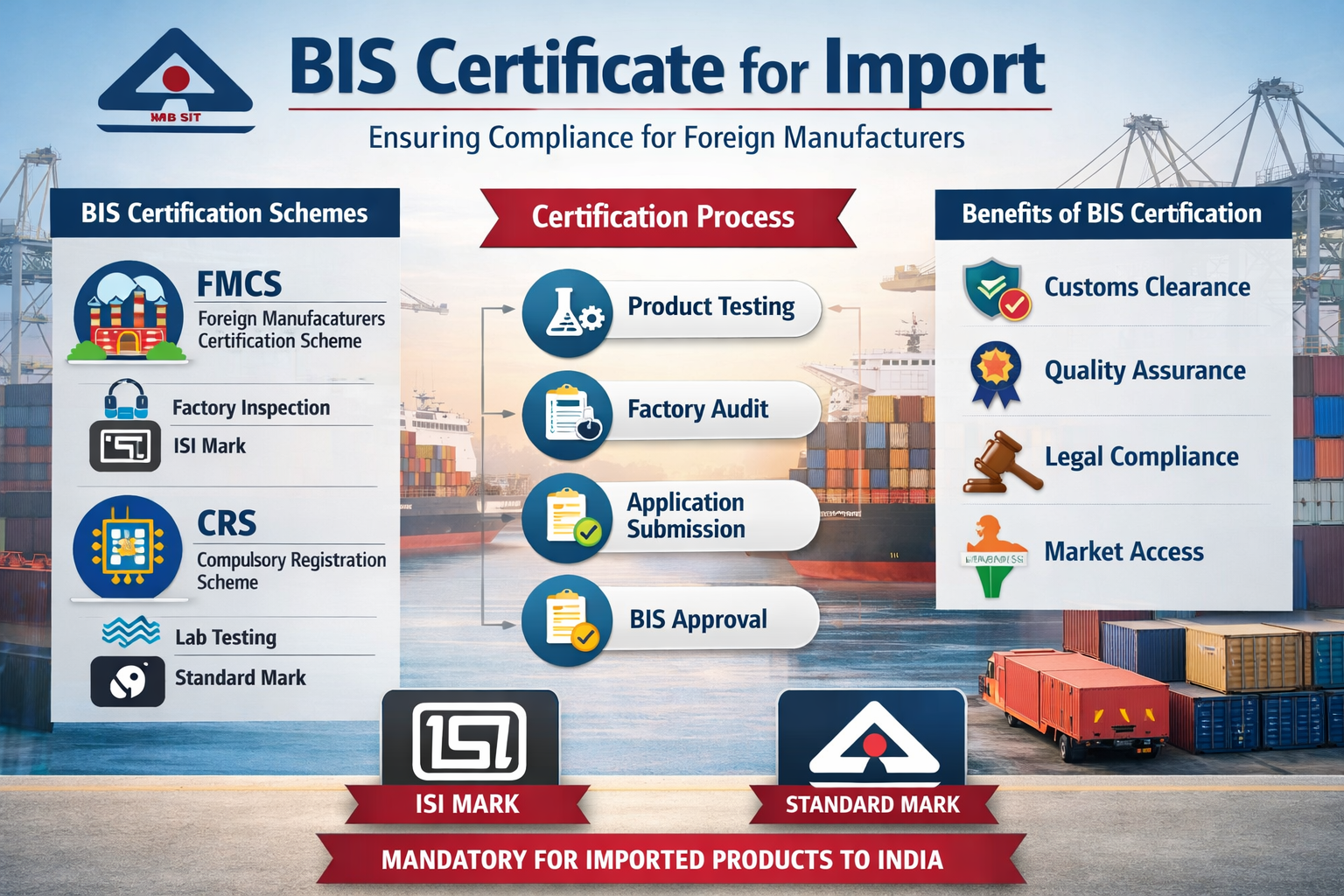
India is one of the world’s fastest-growing import markets, but entering it requires strict regulatory compliance. Complete guide to BIS Certificate for Import covering CRS, FMCS, ISI Mark, and BIS compliance requirements for foreign brands entering India. One of the most critical requirements is obtaining a BIS Certificate for Import. The Bureau of Indian Standards (BIS) ensures that imported products meet Indian safety, quality, and performance standards before they reach consumers. For foreign manufacturers and importers, understanding BIS compliance is essential to avoid shipment delays, penalties, or rejection at Indian ports.
Organizations like Indiannexus play a key role in simplifying the complex approval procedures, helping importers navigate BIS regulations smoothly and efficiently.
What is a BIS Certificate for Import?
A BIS Certificate for Import is an official authorization issued by the Bureau of Indian Standards that allows foreign-manufactured products to be imported and sold in India. This certification confirms that the product complies with applicable Indian Standards (IS).
Depending on the product category, BIS certification for import may be required under:
BIS FMCS (Foreign Manufacturers Certification Scheme)
BIS CRS (Compulsory Registration Scheme)
Without this certification, customs authorities can stop imported goods from entering the Indian market.
Why BIS Certification is Mandatory for Imported Products
India mandates BIS Certification for imports to ensure consumer safety, national security, and quality control. Products such as electronics, steel items, cement, toys, electrical appliances, and industrial goods must comply with BIS standards.
Key reasons include:
Protection of consumers from substandard imports
Uniform quality standards across domestic and imported products
Legal compliance with Indian regulations
Smooth customs clearance
Failure to obtain BIS Registration for import can result in heavy fines, shipment confiscation, or permanent import bans.
BIS Schemes Applicable for Importers
1. BIS FMCS (Foreign Manufacturers Certification Scheme)
Under BIS FMCS, foreign manufacturers must obtain certification directly from BIS. The manufacturing unit is audited, samples are tested in BIS-recognized labs, and compliance is verified before granting the ISI Mark or Standard Mark.
This scheme is widely used for:
Industrial products
Construction materials
Safety-critical goods
2. BIS CRS (Compulsory Registration Scheme)
BIS CRS applies mainly to electronic and IT products. Under this scheme, manufacturers register their products after testing them in BIS-approved laboratories. Once approved, products can carry the Standard Mark.
BIS Certificate for Import Process
The process of obtaining a BIS Certificate for Import generally includes:
Product identification under applicable Indian Standards
Selection of the BIS scheme (FMCS or CRS)
Product testing in BIS-recognized laboratories
Factory inspection (mandatory under FMCS)
Application submission with technical documents
Grant of BIS Certification
Marking with ISI Mark or Standard Mark
Professional assistance from a BIS Certification Consultant significantly reduces errors and approval timelines.
Role of BIS Registration Consultants
Navigating BIS regulations can be challenging for foreign entities unfamiliar with Indian compliance systems. A trusted BIS Registration consultant, such as Indiannexus, provides end-to-end support, including:
Product standard identification
Coordination with BIS labs
Documentation and application filing
Liaison with BIS officials
Post-certification compliance
With expert guidance, importers can secure BIS ISI Certification for imported products without unnecessary delays.
Importance of ISI Mark and Standard Mark
The ISI Mark and Standard Mark signify that a product meets Indian quality and safety benchmarks. Imported goods bearing these marks gain:
Faster customs clearance
Higher consumer trust
Market acceptance across India
Legal authorization for sale
For many products, ISI Registration for Import is mandatory and non-negotiable.
Why Choose Indiannexus for BIS Certification for Import
Indiannexus is a reputed BIS Certification Consultant offering specialized services for foreign manufacturers and importers. Their expertise in BIS Registration for import, FMCS approvals, and CRS compliance ensures:
Accurate documentation
Faster approvals
End-to-end regulatory support
Reduced compliance risks
Their structured approach makes the BIS Certificate for the Import process transparent and hassle-free.
Conclusion
Obtaining a BIS Certificate for Import is not just a legal formality but a critical step toward successful market entry in India. With multiple schemes, technical requirements, and strict enforcement, professional support becomes essential. By working with experienced consultants like Indiannexus, importers can ensure full compliance, faster approvals, and uninterrupted access to the Indian market.
FAQs – BIS Certificate for Import
1. Is a BIS Certificate for Import mandatory for all products?
No, only products notified by BIS under FMCS or CRS require mandatory certification.
2. What is the validity of BIS Certification for Import?
Validity depends on the scheme and product category, generally ranging from 1 to 5 years.
3. Can an importer apply for BIS certification instead of a manufacturer?
Under FMCS, the foreign manufacturer must apply, while importers act as Authorized Indian Representatives.
4. What is the difference between BIS FMCS and BIS CRS?
FMCS involves factory inspection and licensing, while CRS is a registration-based scheme mainly for electronics.
5. How long does BIS Registration for Import take?
The process may take 3–6 months, depending on product type and document readiness.
6. What happens if products are imported without BIS Certification?
Such products may be seized, rejected, or destroyed by Indian customs authorities.
7. Why hire a BIS Certification Consultant?
A consultant ensures correct documentation, faster approvals, and compliance with evolving BIS regulations.